
Anthotyros
Ανθότυρος (νωπός και ξηρός)
Say it: an-THO-tee-ros
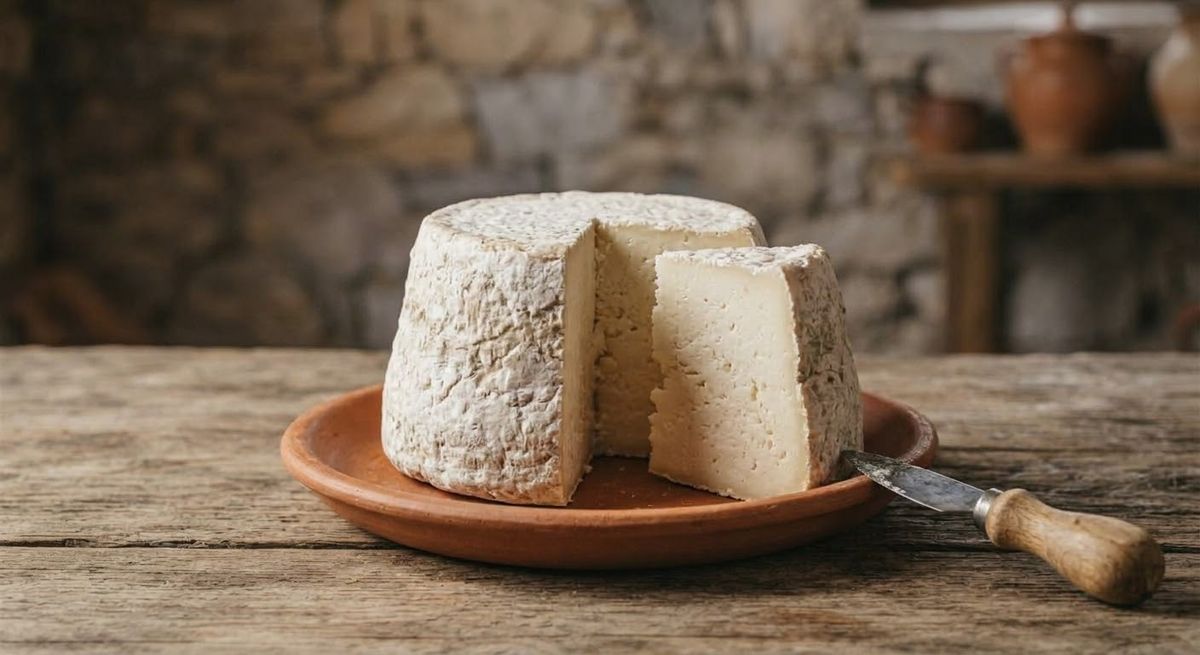
A whey cheese enriched with fresh milk. Eaten fresh and mild, or salted and dried into hard, gratable xeros anthotyros.
- Made from
- Whey + 10 to 20% milk
- Type
- Whey cheese
- Forms
- Fresh, or dried
- Protection
- Traditional, not PDO
Origin
Where it is made
Made across Crete, where it originated; now made throughout Greece.
West to east. Schematic only, not to scale.
History
The story
Anthotyros, “flower cheese”, originated in Crete and is now made all over Greece (Pappa & Kondyli, 2023). It is made from the whey left from other cheeses, enriched with fresh milk.
Fresh anthotyros is soft and mild. Salted and dried, it becomes xeros (dry) anthotyros: firm, savoury and perfect for grating, a way of keeping the spring milk for the rest of the year.
Raw material
Milk and proportions
Whey from sheep's or goat's milk, left from hard, semi-hard or soft cheeses (Pappa & Kondyli, 2023). Cretan dairies add 10 to 20% fresh milk to the whey (called choumas locally) (Kritiko Ergastiri, n.d.); one technical description uses 10% raw sheep's or goat's milk (Pappa & Kondyli, 2023). The added milk is what makes it richer than plain myzithra.
From milk to cheese
How it is made
Steps follow (Pappa & Kondyli, 2023).
- HeatingFiltered whey is heated with stirring; fresh milk and a little salt are added.
about 70 °C, 0.5% salt - FlakingFine flakes of whey protein rise to the surface.
about 80 °C - CookingStirring stops and the curd is held to firm up.
about 90 °C, 20 min - DrainingThe curd is moved to cloth-lined moulds and drains.
3 to 4 hours - Fresh cheeseChilled and sold fresh.
about 5 °C - Dry anthotyrosFor the dry form, the cheese is salted more heavily and left to dry until firm, with moisture below 40%.
Composition
What is in it
| Fresh: moisture | about 65 to 68% |
|---|---|
| Fresh: fat | about 14 to 17% |
| Fresh: salt | about 0.5 to 0.6% |
| Dry: moisture | 40% maximum |
| Dry: fat in dry matter | 65% minimum |
Source (Pappa & Kondyli, 2023).
Legal status
Legislation
| Status | Traditional cheese, not registered as an EU PDO or PGI. |
|---|---|
| Greek Food Code | Classed as a whey cheese: made by strong heating of whey, with or without added milk or cream, with a legal maximum moisture of 70%. Ripened whey cheeses follow the same 2-month ripening rule as soft cheeses (Hellenic Republic, 2020) |
Tasting notes
Look, smell and taste
Look
Fresh: white and moist. Dry: off-white, firm, with a thin dry surface.
Texture
Fresh: soft and slightly grainy. Dry: hard and crumbly.
Aroma
Clean and milky.
Taste
Fresh: mild and slightly sweet. Dry: savoury and salty.
At the table
How it is used
Fresh: with honey, in kalitsounia and other pies, in salads. Dry: grated over pasta, especially with tomato sauce, and over vegetables and eggs; also as a table cheese (Pappa & Kondyli, 2023).
At home
How to store it
Fresh anthotyros is perishable: keep it in the fridge and eat within a few days. Dry anthotyros keeps for weeks wrapped in paper in the fridge; grate only what you need.
Share
Product card
Download a card with the name of the product and a QR code that opens this page.
Take this page with you
Scan the code to open this page on your phone, or visit .
References
- Hellenic Republic. (2020). Greek Food and Beverages Code, Article 83: Cheese products [In Greek]. Independent Authority for Public Revenue. https://www.aade.gr/sites/default/files/2020-03/83-iss3.pdf
- Kritiko Ergastiri. (n.d.). Protes yles [Our raw materials; In Greek]. https://ergastiri.gr/prwtes-yles/
- Pappa, E. C., & Kondyli, E. (2023). Descriptive characteristics and cheesemaking technology of Greek cheeses not listed in the EU geographical indications registers. Dairy, 4(1), 43–67. https://doi.org/10.3390/dairy4010003