
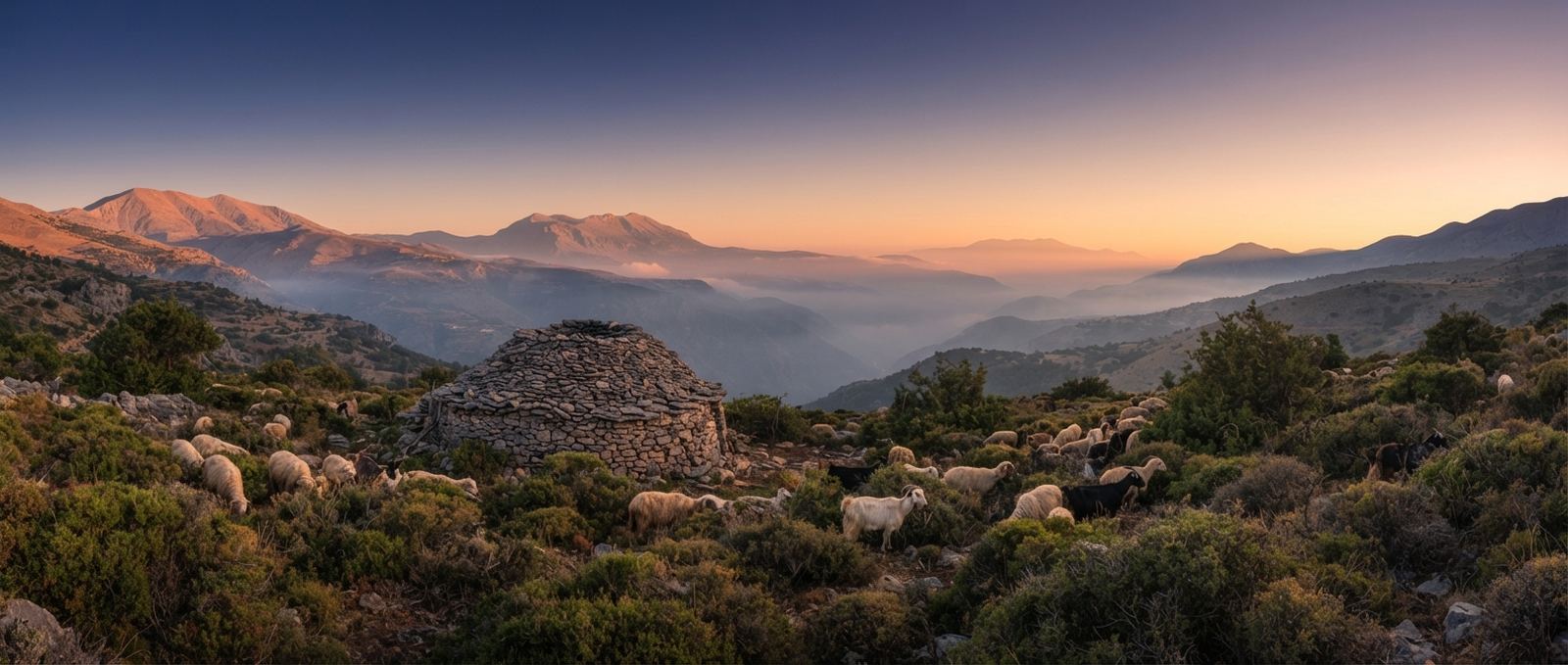
Nine thousand years ago the first farmers brought sheep and goats to Crete by boat. Since then, through Minoan palaces, Venetian and Ottoman rule and countless summers in the mountains, cheese has been part of everyday life on the island, and at times one of its exports. This is its story, from the first flocks to the protected cheeses of today, told from archaeology, historical records and modern science.
-
c. 7000 BCE
The first flocks
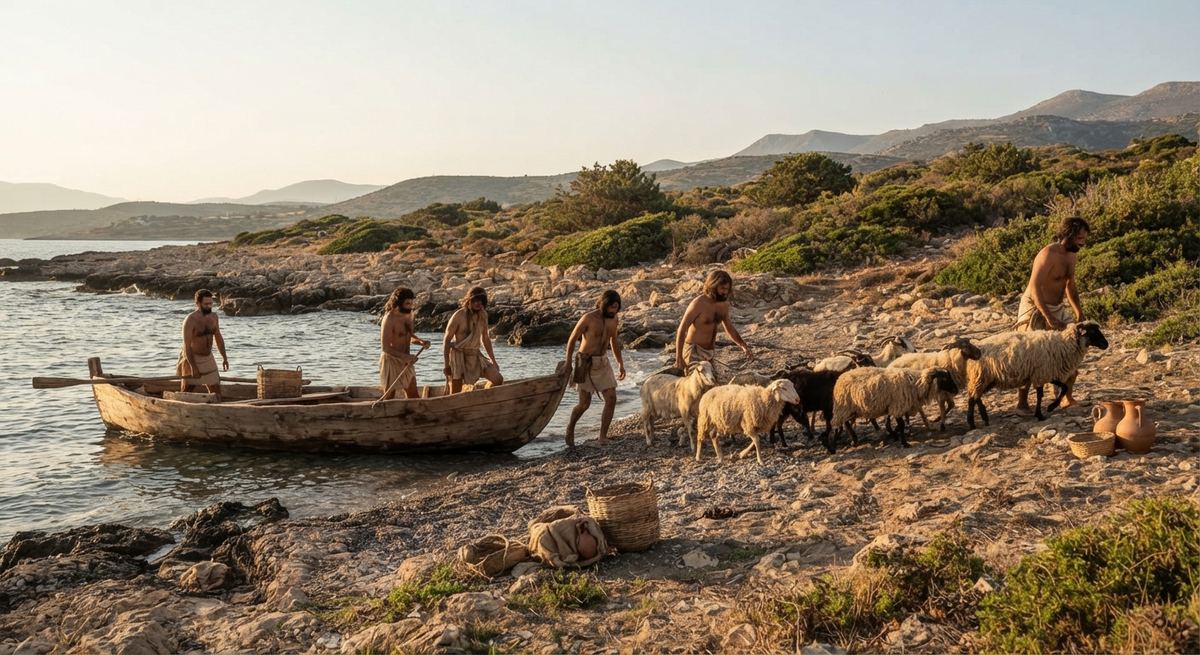
Illustration, reconstruction Crete had no wild sheep or goats. Every animal in the island's flocks descends from animals brought by sea. The earliest farmers at Knossos arrived with sheep, goats, cattle and pigs, and bones of all four species lie in the lowest layers of the site, carbon-dated to around 7000 BCE (Shapland, n.d.).
Chemistry tells us what they did with the milk. Fat residues absorbed into the walls of cooking pots show that farmers across the northern Mediterranean were using milk and dairy products from the very beginning of farming, some 9,000 years ago. Because most adults then could not digest fresh milk, it was almost certainly turned into soured milk, yogurt-like foods and cheese (Debono Spiteri et al., 2016). The rugged, dry Cretan landscape suited sheep and goats far better than cattle, and so it has remained.
-
Myth
A goat in a mountain cave
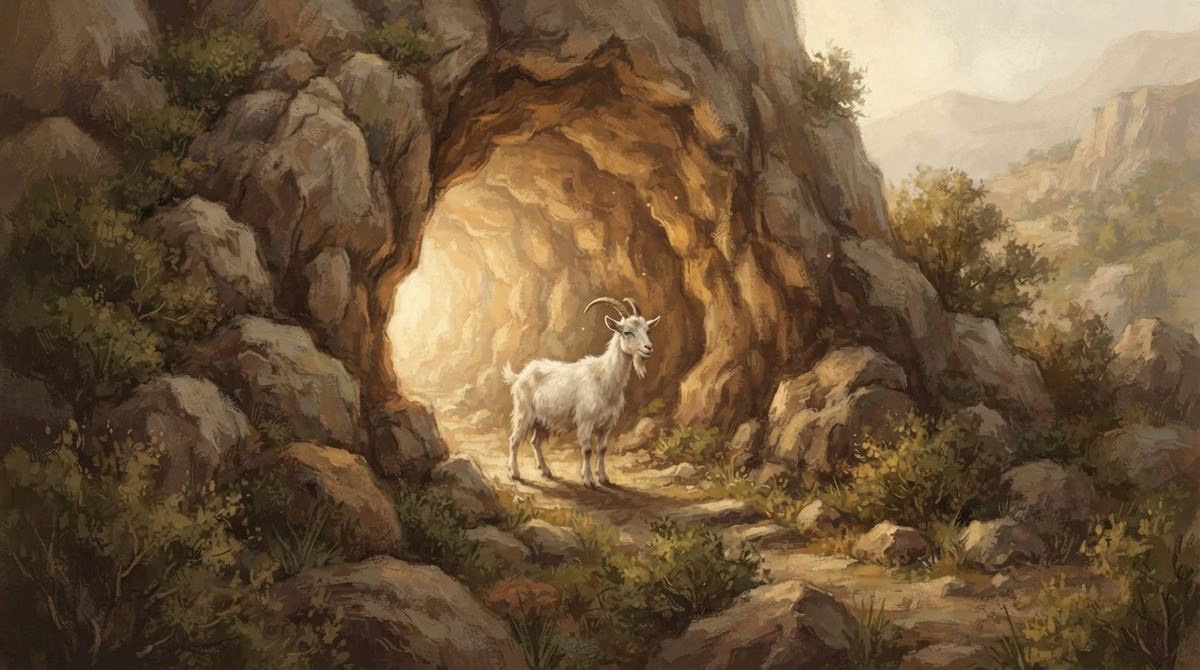
Illustration In Greek myth, Zeus was born on Crete. His mother hid him from his father Kronos in a cave on Mount Dikte, where nymphs raised him on honey and on the milk of the goat Amaltheia (Apollodorus, Library 1.1.6–1.1.7). One of her horns became the cornucopia, the horn of plenty.
It is a legend, not history. But it shows that for the ancient Greeks, Crete was a land of mountain caves, goats and milk, an image any visitor to the island's uplands will still recognise.
-
c. 2000 to 1350 BCE
Minoan palaces
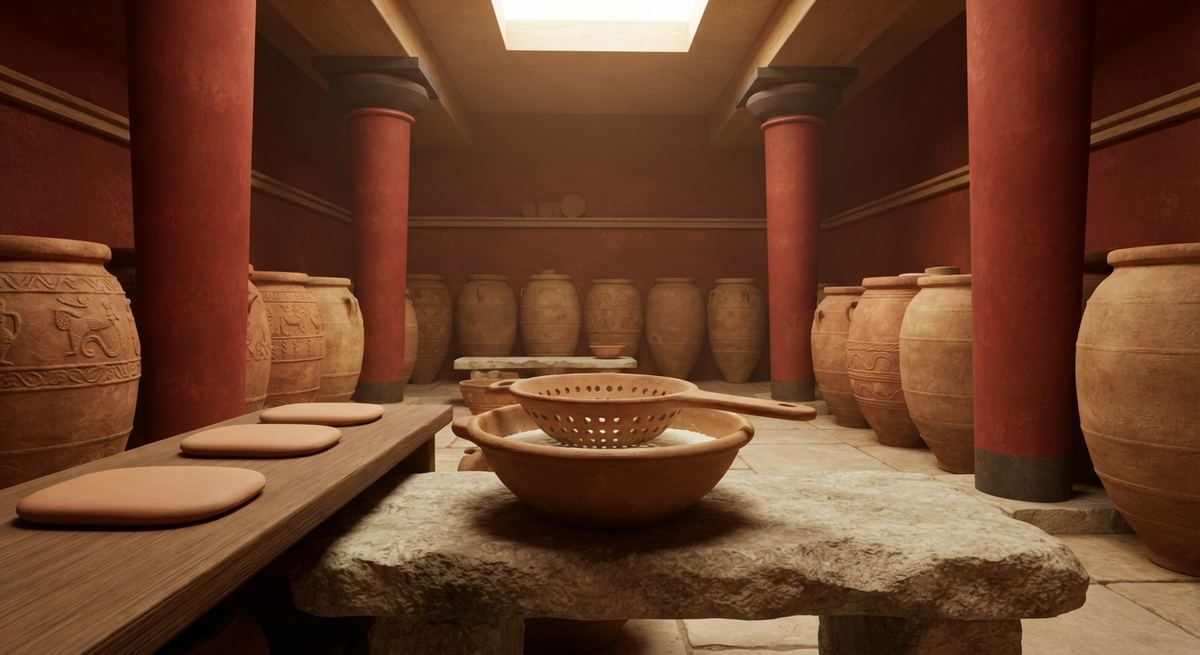
Illustration, reconstruction The Minoans built Europe's first palaces at Knossos, Phaistos, Malia and Zakros, and with them came storerooms, scribes and accounts. At Knossos, Arthur Evans found a perforated clay disc with a low rim that may have served as a cheese strainer (Evans, 1935, p. 736). Pierced clay vessels for draining curd are also known from Palaikastro in eastern Crete (European Commission, 2011).
The palace administration kept careful count of the flocks. Clay tablets written in Linear B, the earliest form of written Greek, record some 100,000 sheep at Knossos, kept mainly for their wool (Shapland, n.d.). One tablet notes that a man named Akmonios held 57 rams and 23 ewes, with 20 rams still missing (Judson, n.d.). Linear B scribes even had a dedicated sign for cheese, known to scholars as TURO2 (Unicode Consortium, 2025). Cheese was by then a commodity worth counting.
-
c. 1000 BCE to 1200 CE
Goats on coins, sour milk in pots
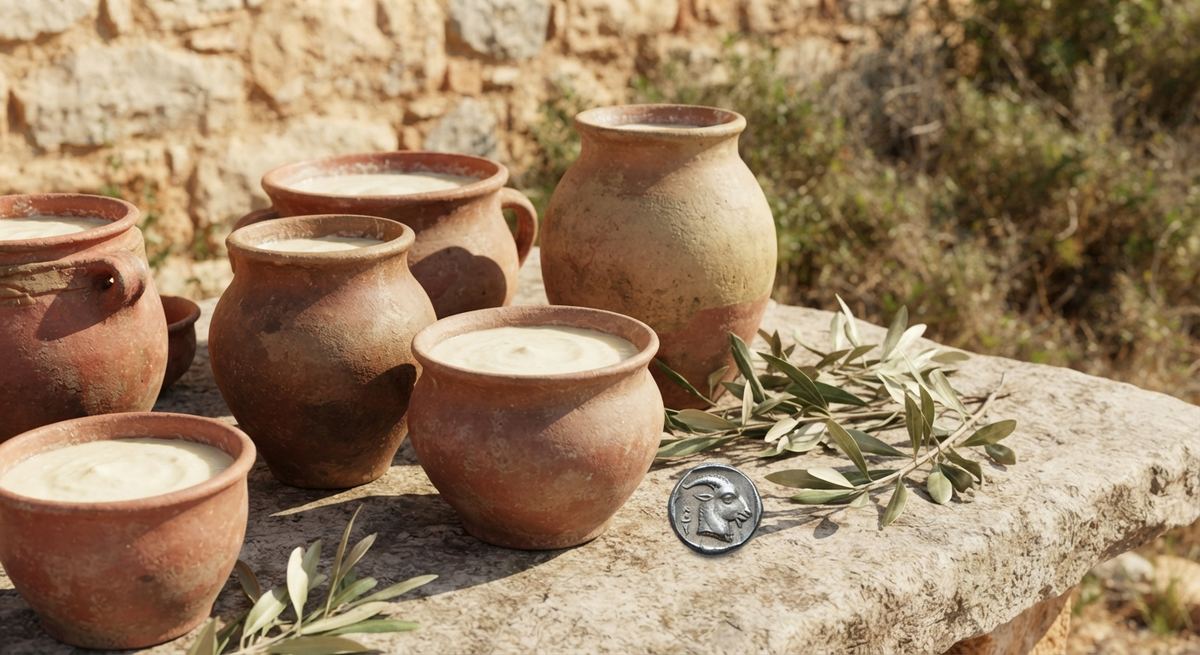
Illustration The ancient city of Praisos in eastern Crete struck coins showing goats (European Commission, 2011), a sign of how central herding was to its economy. Ancient Greek had a word, oxygala, for soured milk. It survives almost unchanged in the name of Xygalo, the soft cheese of Sitia (Lapidakis & Fragkiadakis, 2022).
Across the Greek world, cheese was everyday food. When Odysseus enters the Cyclops' cave, the first thing he sees are racks heavy with cheeses and pens full of lambs and kids (Homer, Odyssey 9.219). Through the Roman and Byzantine centuries, Cretan shepherds kept making cheese in much the same way, even though few written records survive from this long period.
-
1205 to 1669
Venetian Candia
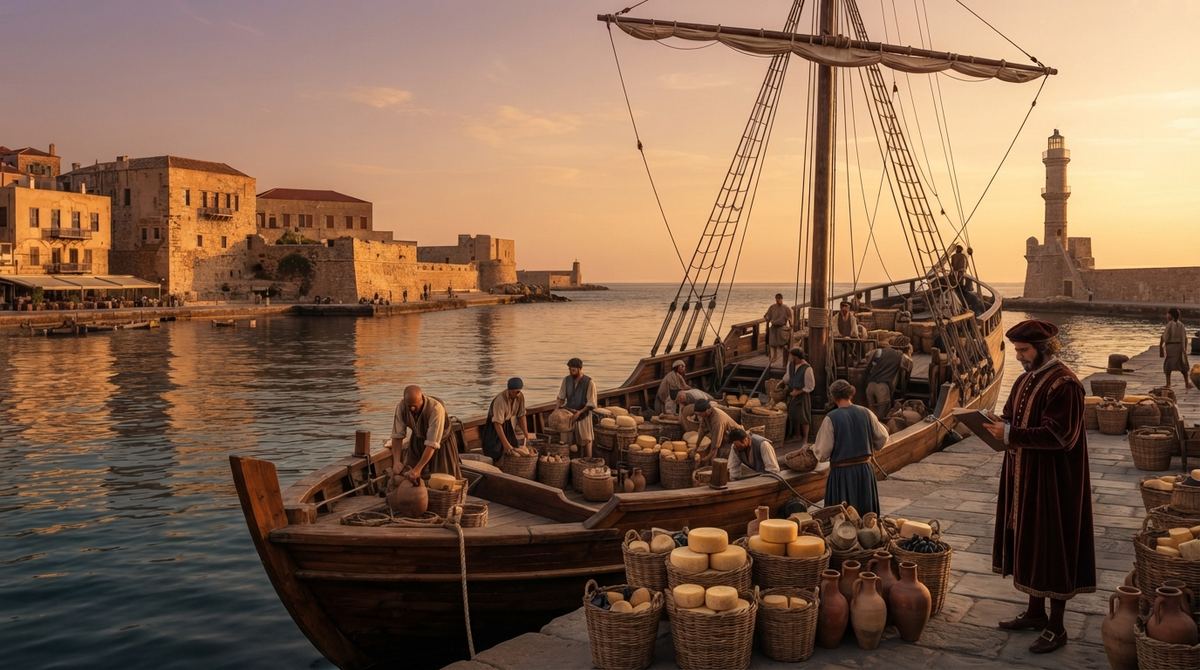
Illustration, reconstruction In 1205 Venice took control of Crete, which it called the Kingdom of Candia, and held it for more than four and a half centuries. Its main exports were wheat and sweet Malmsey wine, followed by timber and cheese (“Kingdom of Candia,” n.d.).
Cheese was valuable enough to shape policy. Merchants advanced money to shepherds against their future cheeses so they could buy more sheep. Venice tried to curb this speculation but had to bend its rules to the needs of cheesemaking, because cheese was one of the foods Crete sold abroad. Egypt in particular bought Cretan cheese (Zacour & Hazard, 1985, p. 292). Records from 1347 to 1450 describe cheese leaving the port of Sitia for Venice, Egypt and Cyprus (European Commission, 2011).
-
1669 to 1898
Ottoman Crete
After the long siege of Candia ended in 1669, Crete became part of the Ottoman Empire. Historians once described this as the start of economic decline, but recent research shows the island's economy was managed from within and became more closely tied to the wider eastern Mediterranean. From the 1720s, for example, soap works multiplied and Crete exported more soap and less raw olive oil (Fleet, 2014). In the mountains, herding remained the backbone of life.
In the 19th and early 20th centuries, the two main dairy products of shepherds in the Dikti mountains were wheels of hard kefalotyri and soft myzithra, and the White Mountains of western Crete were regarded as the island's chief cheese-producing area (Blitzer, 1990).
-
Centuries of summers
Life in the mitata
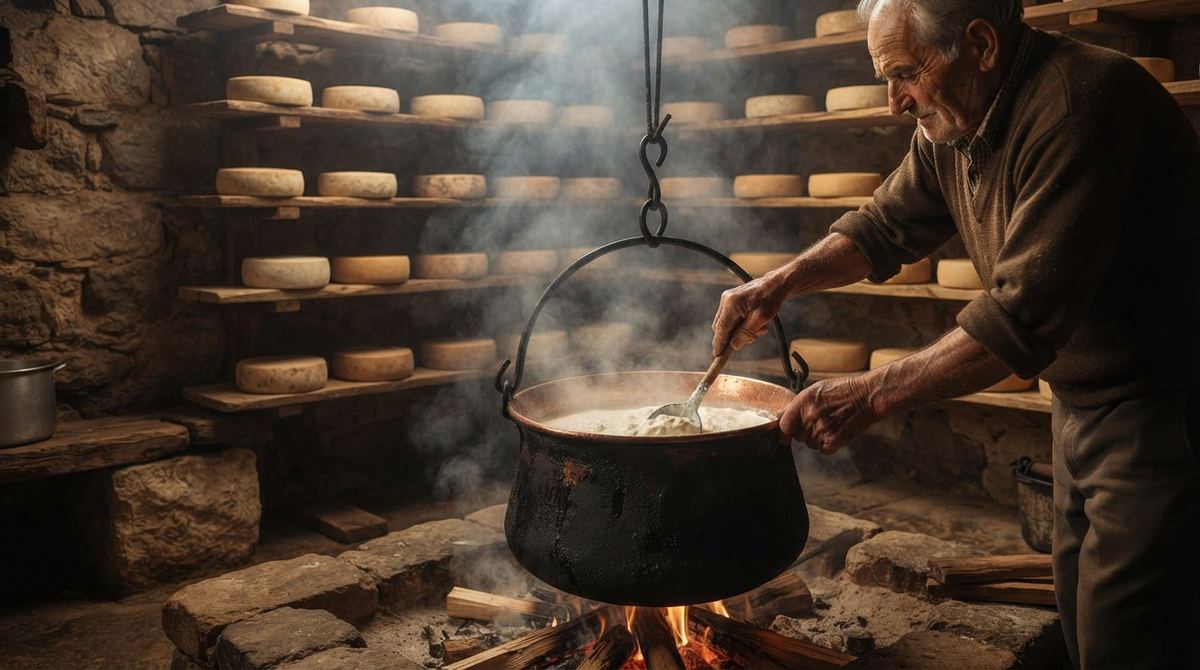
Illustration Cretan herding followed the seasons. Each family had a lowland holding, the metochi, with olive trees and a house, and a summer base in the mountains (Blitzer, 1990). In spring the flocks were driven up to the plateaus of the White Mountains, Psiloritis and Dikti, and returned to the lowlands before winter.
High on the mountain stood the mitato: a round hut of dry stone with a corbelled stone roof. Inside were the hearth and cheese-making area, small stone cupboards built into the walls for tools and food, and a hole at the top of the dome to let out the smoke. Around it lay the stone pen where the flock gathered (Gomega, n.d.). Beside the mitato usually stood a second, almost identical room, the tyrokeli or cheese cellar, with a lower door and no opening in the roof, where the cheeses ripened in the cool and dark (Destination Crete, n.d.).
Milk was turned into cheese on the day it was drawn, in a copper cauldron over a wood fire. The curd became hard cheeses; the whey was heated again to make myzithra, so nothing was wasted (Blitzer, 1990; Plymakis, 2008). Many mitata still stand on Psiloritis and the White Mountains, and a few are still in use.
-
1914 onward
A new cheese: graviera
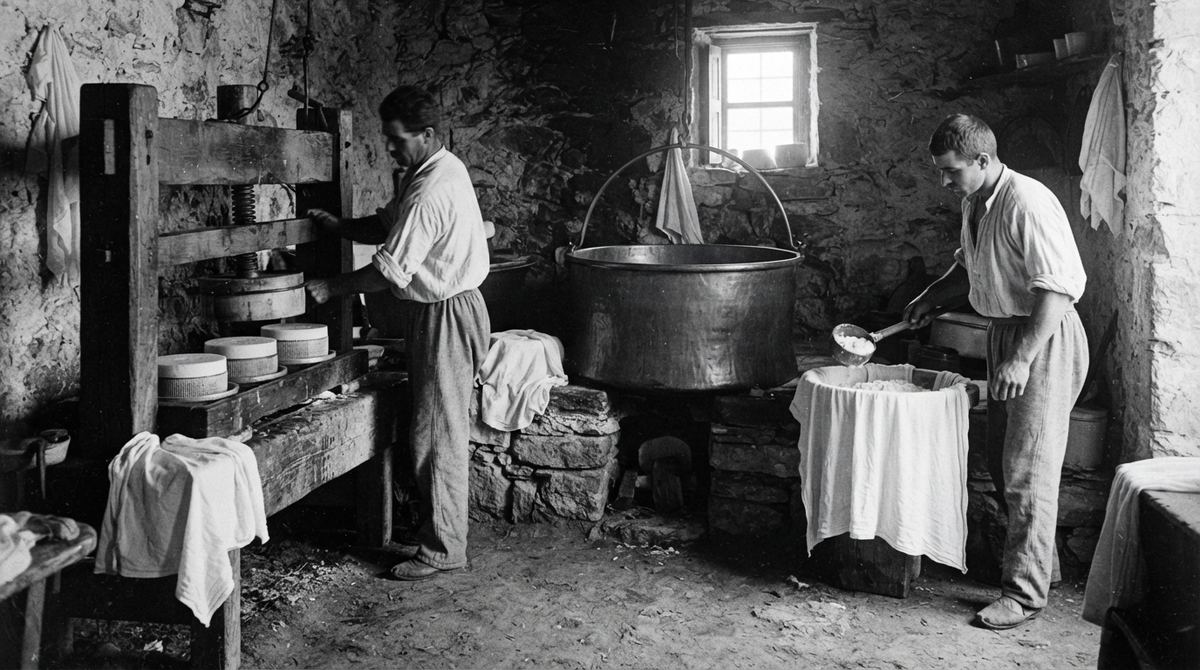
Illustration, not a historical photograph The first Greek graviera was made in 1914 in the Peloponnese, following the recipe for Swiss Gruyère (Ambrosia Magazine, n.d.). Cretan cheesemakers took up the method but used what their island had: sheep's milk, with a little goat's milk. The cooked, pressed curd and long ripening produced a cheese sweeter and more buttery than its Swiss model, and better suited to travel and storage than the old fresh cheeses.
Through the 20th century, cheesemaking moved steadily from the mountain huts into village dairies, cooperatives and family businesses, many of which are still run by the founders' grandchildren and great-grandchildren. Graviera became Crete's signature cheese, while kefalotyri, myzithra, anthotyros and the old soured-milk cheeses lived on beside it.
-
1994 to 2011
Protected by law
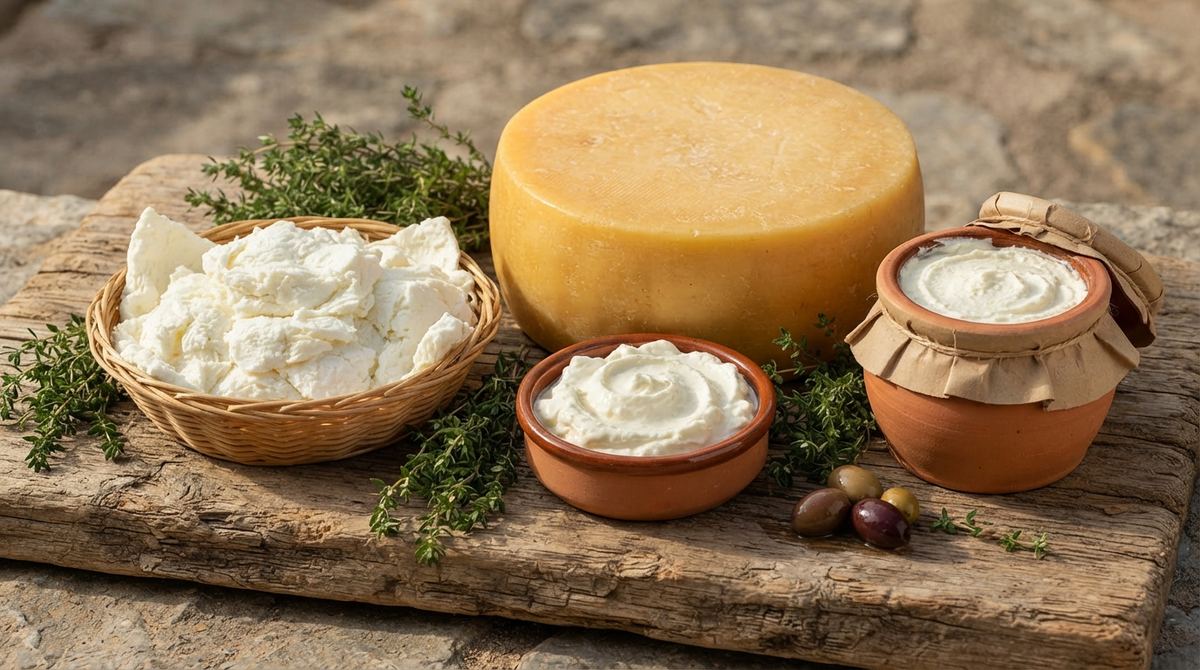
Illustrative image In 1994 Greece set out the specification for Graviera Kritis: Cretan sheep's milk with no more than 20% goat's milk, made anywhere on the island and ripened for at least three months (Hellenic Ministry of Agriculture, 1994). In 1996 the European Union registered it as a Protected Designation of Origin (European Commission, 1996), and Xinomyzithra Kritis and Pichtogalo Chanion joined it in the same decade.
Xygalo Siteias followed in 2011. Its specification gathers the evidence for its long local history, from the Minoan strainers of Palaikastro to the medieval exports from Sitia; the cheese itself was first described in writing in 1957 (European Commission, 2011). Today these four cheeses can only be made in their defined areas, from local milk, by the traditional method.
-
Today
Old knowledge, new science

Illustrative image Crete keeps more than a million sheep and goats. Over 80% of the ewes belong to the hardy local Sfakia breed. Research on Cretan flocks found that ewes kept the traditional way, grazing diverse native mountain pastures, give milk with more omega-3 fatty acids than ewes in more intensive systems, even though the intensive flocks give more milk (Voutzourakis et al., 2020).
Science can now read the island in its cheese. Graviera Kritis shares aromatic terpenes with the plants of its pastures (Bozoudi et al., 2016), contains trace elements linked to Crete's soils, and can be told apart from gravieras made elsewhere by its chemical fingerprint (Ralli & Spyros, 2023).
The challenge now is to keep the flocks. The shrinking number of sheep and goats on the island has been raised in the Greek Parliament as a threat to the supply of milk for Graviera Kritis (Hellenic Parliament, 2022). The future of Cretan cheese depends, as it always has, on shepherds and their animals in the mountains.
Taste the story
Meet the cheeses themselves: all the cheeses of Crete, or start with Graviera Kritis.
References
- Ambrosia Magazine. (n.d.). [Article on Greek graviera and its protected varieties]. https://ambrosiamagazine.com/?p=1892
- Apollodorus. (1921). The library (J. G. Frazer, Trans.; Vol. 1). Harvard University Press. (Original work published ca. 1st–2nd century C.E.)
- Blitzer, H. (1990). Pastoral life in the mountains of Crete: An ethnoarchaeological perspective. Expedition, 32(3), 34–41.
- Bozoudi, D., Pavlidou, S., Kotzamanidis, C., Georgakopoulos, P., Torriani, S., Kondyli, E., Claps, S., Belibasaki, S., & Litopoulou-Tzanetaki, E. (2016). Graviera Naxou and Graviera Kritis Greek PDO cheeses: Discrimination based on microbiological and physicochemical criteria and volatile organic compounds profile. Small Ruminant Research, 136, 161–172. https://doi.org/10.1016/j.smallrumres.2016.01.022
- Debono Spiteri, C., Gillis, R. E., Roffet-Salque, M., et al. (2016). Regional asynchronicity in dairy production and processing in early farming communities of the northern Mediterranean. Proceedings of the National Academy of Sciences, 113(48), 13594–13599. https://doi.org/10.1073/pnas.1607810113
- Destination Crete. (n.d.). The mitata of Nida, Rethymno. https://www.destinationcrete.gr/?p=432
- European Commission. (1996). Commission Regulation (EC) No 1107/96 of 12 June 1996 on the registration of geographical indications and designations of origin under the procedure laid down in Article 17 of Council Regulation (EEC) No 2081/92. Official Journal of the European Communities, L 148.
- European Commission. (2011). Commission Implementing Regulation (EU) No 766/2011 entering a name in the register of protected designations of origin and protected geographical indications [Xygalo Siteias (PDO)], with product specification. Official Journal of the European Union.
- Evans, A. (1935). The palace of Minos at Knossos (Vol. 4, Pt. 2). Macmillan.
- Fleet, K. (2014). From Crete to Bulgaria. In K. Fleet & S. Ianeva, Ottoman economic practices in periods of transformation: The cases of Crete and Bulgaria. Türk Tarih Kurumu.
- Gomega. (n.d.). Mitato. https://www.gomega.gr/en/destinations-203/mitato/
- Hellenic Ministry of Agriculture. (1994). Ministerial Decision 313047/1994 recognising the protected designation of origin “Graviera Kritis” [In Greek]. Government Gazette of the Hellenic Republic.
- Hellenic Parliament. (2022, September 19). Parliamentary question to the Minister of Rural Development and Food on the protection of Graviera Kritis PDO [In Greek]. https://www.hellenicparliament.gr/UserFiles/c0d5184d-7550-4265-8e0b-078e1bc7375a/12069165.pdf
- Homer. (1996). The Odyssey (R. Fagles, Trans.). Penguin. (Original work published ca. 8th century B.C.E.)
- Judson, A. P. (n.d.). How to write a Linear B tablet [Teaching handout]. Wesleyan University. https://www.wesleyan.edu/classics/events/Linear%20b2.pdf
- Kingdom of Candia. (n.d.). In Wikipedia. https://en.wikipedia.org/wiki/Kingdom_of_Candia
- Lapidakis, N., & Fragkiadakis, G. A. (2022). Dairy processing: The soft spreadable cheese Xygalo Siteias. Processes, 10(1), 80. https://doi.org/10.3390/pr10010080
- Plymakis, A. (2008). Koumoi, mitata kai voskoi sta Lefka Ori kai ston Psiloriti [Koumoi, mitata and shepherds in the White Mountains and Psiloritis]. Self-published.
- Ralli, E., & Spyros, A. (2023). A study of Greek graviera cheese by NMR-based metabolomics. Molecules, 28(14), 5488. https://doi.org/10.3390/molecules28145488
- Shapland, A. (n.d.). Dining with the Minoans. Ashmolean Museum. https://ashmolean.org/node/3007031
- Unicode Consortium. (2025). Linear B ideograms: Range 10080–100FF [Code chart]. In The Unicode Standard (Version 17.0). https://www.unicode.org/charts/PDF/U10080.pdf
- Voutzourakis, N., Tzanidakis, N., Stergiadis, S., Rempelos, L., Eyre, M., Atsali, I., Franceschin, E., Leifert, C., Stefanakis, A., Sotiraki, S., & Butler, G. (2020). Sustainable intensification? Increased production diminishes omega-3 content of sheep milk. Sustainability, 12(3), 1228. https://doi.org/10.3390/su12031228
- Zacour, N. P., & Hazard, H. W. (Eds.). (1985). A history of the Crusades: Vol. 5. The impact of the Crusades on the Near East (K. M. Setton, Gen. Ed.). University of Wisconsin Press.