 Hard cheese
Graviera Kritis
Γραβιέρα Κρήτης
Say it: gra-VYE-ra KREE-tees
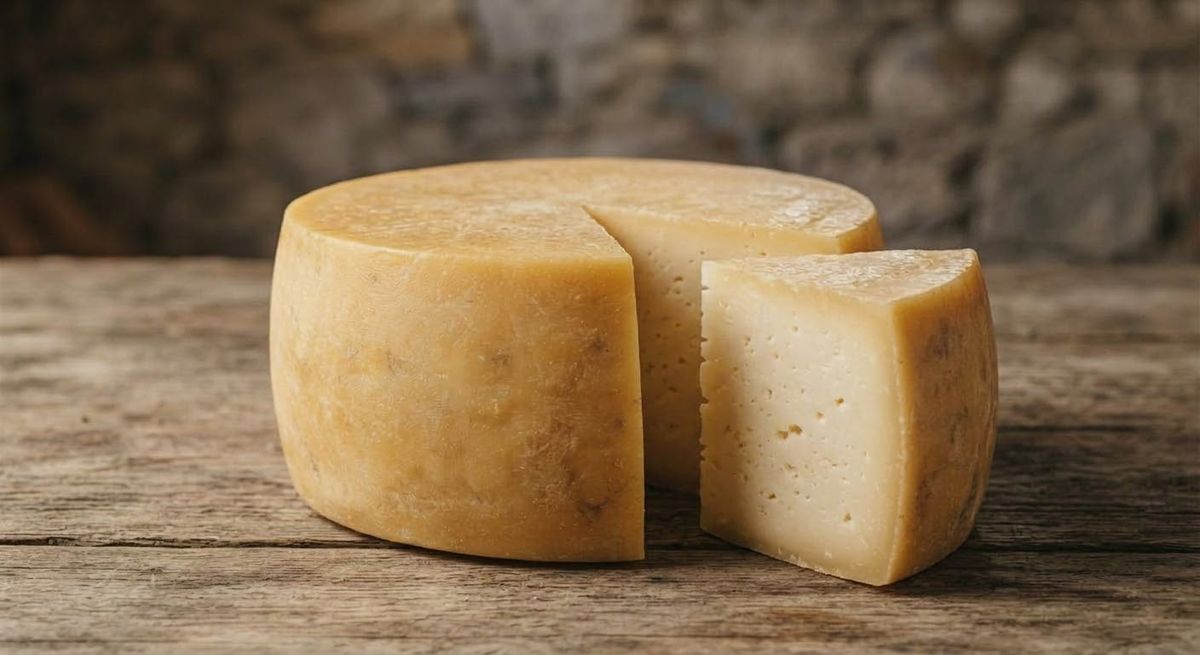
Crete's best-known cheese: a hard, sweet and nutty wheel made mainly from sheep's milk, ripened for at least three months.
- Milk
- Sheep, up to 20% goat
- Type
- Hard, cooked curd
- Ripening
- 3 months or more
- EU PDO since
- 1996
Origin
Where it is made
Graviera Kritis may only be made in the four regional units of Crete, from milk produced there.
Chania
Rethymno
Heraklion
Lasithi
West to east. Schematic only, not to scale.
History
The story
Graviera is a 20th-century cheese built on a very old herding tradition. The method came from Swiss Gruyère, but Cretan cheesemakers used what the island had: the milk of sheep and goats grazing dry, herb-rich mountain pastures. Over 80% of Cretan ewes belong to the hardy local Sfakia breed (Voutzourakis et al., 2020).
Science confirms what Cretans say about its taste of place. Graviera Kritis shares aromatic terpenes with the plants of its pastures (Bozoudi et al., 2016), and it can be told apart from gravieras made elsewhere by its chemical fingerprint (Ralli & Spyros, 2023).
Raw material
Milk and proportions
Whole sheep's milk, or a mixture of sheep's and goat's milk in which goat's milk does not exceed 20% by weight. The milk must come from Crete, from traditional breeds adapted to the area and fed on local flora, collected at least 10 days after lambing or kidding. It is used whole, thermised or pasteurised (Hellenic Republic, 2020). Milk powder, concentrated milk, milk proteins and caseinates are prohibited (Hellenic Ministry of Agriculture, 1994a).
From milk to cheese
How it is made
Steps follow (Hellenic Ministry of Agriculture, 1994a; Hellenic Republic, 2020).
SettingThe milk is curdled with traditional rennet or equivalent enzymes. Calcium chloride (up to 20 g per 100 kg of milk) and harmless lactic cultures may be added.
34 to 36 °C
CuttingAbout 30 minutes after setting, the curd is cut into small grains.
CookingThe curd is reheated with continuous stirring.
50 to 52 °C
Moulding and pressingThe curd is placed in round moulds and pressed into wheels.
RestingThe fresh wheels rest for one day.
14 to 16 °C, about 85% humidity
BriningWheels go into brine for up to 5 days, depending on size.
8 to 20 °Bé
RipeningIn ripening rooms, with regular turning and up to 10 dry salts of the surface, while a natural rind forms. At least 3 months in total.
14 to 18 °C, 85 to 90% humidity
Composition
What is in it
| Moisture | 38% maximum |
|---|
| Fat in dry matter | 40% minimum |
|---|
| Salt | 2% maximum |
|---|
| Additives | Colourings, preservatives and antibiotics prohibited |
|---|
Source (Hellenic Republic, 2020).
Protected Designation of Origin
Legislation
| Greek specification | Ministerial Decision 313047/1994 of the Ministry of Agriculture (Hellenic Ministry of Agriculture, 1994a) |
|---|
| EU registration | Commission Regulation (EC) No 1107/96 of 12 June 1996, registered as a Protected Designation of Origin (PDO) (European Commission, 1996) |
|---|
| Greek Food Code | Article 83, section on PDO cheeses: Graviera Kritis (Hellenic Republic, 2020) |
|---|
| Label | Must read “Graviera Kritis”, carry the PDO indication, the producer, net weight and production date. Cheese made from raw milk must say so on the label (Hellenic Ministry of Agriculture, 1994a; European Parliament & Council, 2004) |
|---|
In numbers
Certified production
Certified PDO Graviera Kritis produced per year, all of Crete (ELGO-DIMITRA, 2026). See all figures.
| Year | Tonnes |
|---|
| 2020 | 3,301 t |
|---|
| 2021 | 3,602 t |
|---|
| 2022 | 3,097 t |
|---|
| 2023 | 3,837 t |
|---|
| 2024 | 3,245 t |
|---|
| 2025 | 3,472 t |
|---|
| 2026 (Jan to Aug) | 2,700 t |
|---|
Tasting notes
Look, smell and taste
Look
Hard, dry, grey-brown natural rind. Inside, off-white to pale yellow, with small scattered holes.
Texture
Firm, compact and elastic.
Aroma
Rich, buttery, with notes of nuts and herbs.
Taste
Pleasant and slightly sweet, with a rich aroma (Hellenic Ministry of Agriculture, 1994a).
At the table
How it is used
Served sliced at room temperature with barley rusks, olives and olive oil; fried as saganaki; grated over pasta and baked dishes; in Cretan pies such as kalitsounia; with thyme honey and walnuts. Good with Vidiano white wine, Liatiko red or tsikoudia.
Cook with it
Recipes
Fried Graviera with thyme honey and sesame
Serves 415 minutesStarter
Ingredients
- 400 g Graviera Kritis, in 1.5 cm slices PDO Crete
- 3 tbsp flour
- 4 tbsp extra virgin olive oil PGI Chania
- 2 tbsp thyme honey Crete
- 1 tbsp toasted sesame seeds
- 1 lemon, in wedges
Method
- Dip the cheese slices in cold water, then coat lightly in flour.
- Heat the olive oil in a heavy pan over medium-high heat.
- Fry the slices for about 1 to 2 minutes a side, until golden and soft inside.
- Drizzle with the honey, scatter the sesame and serve at once with lemon.
Chania boureki: zucchini and potato bake
Serves 61 hour 30 minutesMain course
Ingredients
- 1 kg zucchini, thinly sliced
- 600 g potatoes, thinly sliced
- 400 g fresh myzithra or anthotyros Crete
- 150 g Graviera Kritis, grated PDO Crete
- 1 bunch fresh mint, chopped
- 100 ml extra virgin olive oil PGI Chania
- 3 tbsp flour, salt and pepper
Method
- Heat the oven to 180 °C. Oil a deep baking dish.
- Layer potatoes and zucchini, seasoning each layer with salt, pepper, mint, crumbled myzithra and a little olive oil.
- Finish with zucchini. Sprinkle with the flour mixed with a little water, then the grated Graviera.
- Pour over the remaining olive oil and bake for about 1 hour 15 minutes, until soft and golden on top.
- Let it rest for 15 minutes before cutting.
At home
How to store it
Wrap in waxed or greaseproof paper, then loosely in a container, and keep in the lowest part of the fridge. Do not seal in cling film for long: the cheese needs to breathe. Take it out 30 minutes before serving. Under Greek law, ripened hard cheeses are kept at 0 to 10 °C until sale (Hellenic Republic, 2020).
Share
Product card
Download a card with the name of the product, the EU PDO logo and a QR code that opens this page.
Take this page with you
Scan the code to open this page on your phone, or visit .
References
- Bozoudi, D., Pavlidou, S., Kotzamanidis, C., Georgakopoulos, P., Torriani, S., Kondyli, E., Claps, S., Belibasaki, S., & Litopoulou-Tzanetaki, E. (2016). Graviera Naxou and Graviera Kritis Greek PDO cheeses: Discrimination based on microbiological and physicochemical criteria and volatile organic compounds profile. Small Ruminant Research, 136, 161–172. https://doi.org/10.1016/j.smallrumres.2016.01.022
- ELGO-DIMITRA. (2026). Diacheirisi stoicheion paragomenon proionton [Data on dairy products produced; Dataset, monthly, 2020 to 2026]. data.gov.gr. https://data.gov.gr/dataset/diacheirisi-stoicheion-paragomenon-proionton
- European Commission. (1996). Commission Regulation (EC) No 1107/96 of 12 June 1996 on the registration of geographical indications and designations of origin under the procedure laid down in Article 17 of Council Regulation (EEC) No 2081/92. Official Journal of the European Communities, L 148, 1–10.
- European Parliament & Council of the European Union. (2004). Regulation (EC) No 853/2004 laying down specific hygiene rules for food of animal origin. Official Journal of the European Union, L 139.
- Hellenic Ministry of Agriculture. (1994a). Ministerial Decision 313047/1994 recognising the protected designation of origin “Graviera Kritis” [In Greek]. Government Gazette of the Hellenic Republic.
- Hellenic Republic. (2020). Greek Food and Beverages Code, Article 83: Cheese products [In Greek]. Independent Authority for Public Revenue. https://www.aade.gr/sites/default/files/2020-03/83-iss3.pdf
- Ralli, E., & Spyros, A. (2023). A study of Greek graviera cheese by NMR-based metabolomics. Molecules, 28(14), 5488. https://doi.org/10.3390/molecules28145488
- Voutzourakis, N., Tzanidakis, N., Stergiadis, S., Rempelos, L., Eyre, M., Atsali, I., Franceschin, E., Leifert, C., Stefanakis, A., Sotiraki, S., & Butler, G. (2020). Sustainable intensification? Increased production diminishes omega-3 content of sheep milk. Sustainability, 12(3), 1228. https://doi.org/10.3390/su12031228