
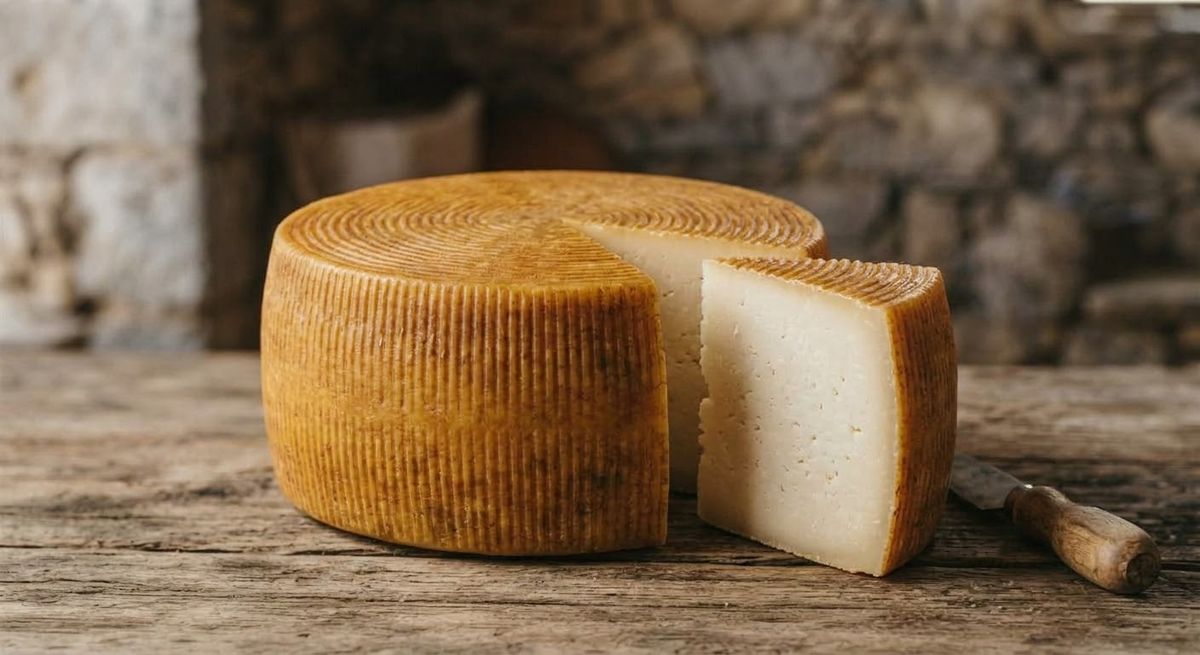
Kefalotyri Kritis
Κεφαλοτύρι Κρήτης
Say it: ke-fa-lo-TEE-ree KREE-tees
A hard, salty and sharp cheese, older than graviera on the island and still loved for grating and frying.
- Milk
- Sheep and goat
- Type
- Hard, cooked curd
- Ripening
- About 90 days
- Protection
- Traditional, not PDO
Origin
Where it is made
Made across Crete. Kefalotyri is a traditional cheese, not an EU protected designation.
West to east. Schematic only, not to scale.
History
The story
Long before graviera arrived, Cretan shepherds made hard wheels of kefalotyri. In the 19th and early 20th centuries the two main dairy products of shepherds in the Dikti mountains were wheels of kefalotyri and soft myzithra (Blitzer, 1990).
Kefalotyri is saltier and sharper than graviera, with a firmer texture. Its name means “head cheese”, from the round shape of the wheel.
Raw material
Milk and proportions
Mainly sheep's or goat's milk, or a mixture; cow's milk can also be used elsewhere in Greece. Sheep's milk is usually standardised to about 5.6% fat. Raw milk was traditional; pasteurised milk is now common (Pappa & Kondyli, 2023). There is no legal ratio between sheep's and goat's milk.
From milk to cheese
How it is made
Steps follow (Pappa & Kondyli, 2023).
- SettingStarter culture and rennet are added.
32 to 36 °C, 30 to 60 min - Cutting and cookingThe curd is cut into small pieces and cooked with stirring.
43 to 45 °C, about 20 min - Moulding and pressingInto moulds about 30 cm wide and 10 to 11 cm high, pressed for 3 to 4 hours.
- SaltingIn brine for 1 to 2 days when the curd pH reaches about 4.8, and/or dry-salted over several days.
18 to 20 °Bé - RipeningThe wheels ripen for about 90 days.
Composition
What is in it
| Moisture | about 33 to 40% at 90 days |
|---|---|
| Fat | about 29 to 36% |
| Salt | about 3.6 to 4.1% |
| pH | about 5.0 to 5.3 |
| Wheel | flat cylinder, 5 to 10 kg |
Source (Pappa & Kondyli, 2023).
Legal status
Legislation
| Status | Not registered as an EU PDO or PGI. (Kefalograviera, a different cheese, is PDO.) |
|---|---|
| Greek Food Code | General rules for ripened cheeses in Article 83 apply, including ripening rooms at no less than 10 °C and storage of hard cheeses at 0 to 10 °C until sale (Hellenic Republic, 2020) |
| Label | Cheese made from raw milk must state it on the label (European Parliament & Council, 2004) |
Tasting notes
Look, smell and taste
Look
Pale yellow, compact, with few small holes.
Texture
Hard and firm; crumbles when aged.
Aroma
Strong, sheepy and savoury.
Taste
Salty and sharp, more piquant than graviera.
At the table
How it is used
Grated over pasta, rice and baked dishes; fried as saganaki; grilled; in pies; as a table cheese with wine or tsikoudia (Pappa & Kondyli, 2023).
At home
How to store it
Wrap in waxed paper and keep in the fridge. Hard cheeses keep for weeks; if mould appears on the surface, cut it away generously.
Share
Product card
Download a card with the name of the product and a QR code that opens this page.
Take this page with you
Scan the code to open this page on your phone, or visit .
References
- Blitzer, H. (1990). Pastoral life in the mountains of Crete: An ethnoarchaeological perspective. Expedition, 32(3), 34–41.
- European Parliament & Council of the European Union. (2004). Regulation (EC) No 853/2004 laying down specific hygiene rules for food of animal origin. Official Journal of the European Union, L 139.
- Hellenic Republic. (2020). Greek Food and Beverages Code, Article 83: Cheese products [In Greek]. Independent Authority for Public Revenue. https://www.aade.gr/sites/default/files/2020-03/83-iss3.pdf
- Pappa, E. C., & Kondyli, E. (2023). Descriptive characteristics and cheesemaking technology of Greek cheeses not listed in the EU geographical indications registers. Dairy, 4(1), 43–67. https://doi.org/10.3390/dairy4010003