
Malaka
Μαλάκα (τυρομάλαμα)
Say it: ma-la-KA
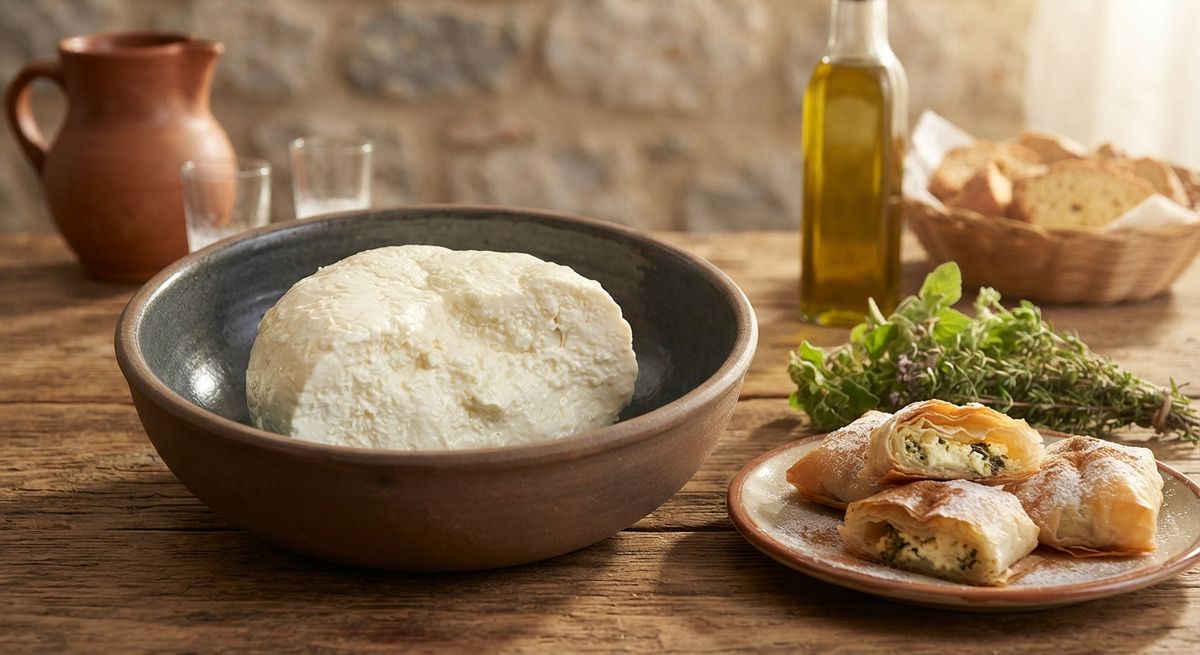
“Raw graviera”: the fresh, elastic curd from the first stage of graviera making, eaten before it is salted and ripened.
- Milk
- Sheep and goat
- Type
- Fresh, elastic curd
- Ripening
- None
- Protection
- Traditional, not PDO
Origin
Where it is made
A speciality of Chania and western Crete.
West to east. Schematic only, not to scale.
History
The story
Malaka is the curd obtained at the first stage of making graviera: elastic and uniform, used mainly in pies (Greek Gastronomy Guide, n.d.). In Chania people use it with all its moisture, before it ripens, which is why it is called “raw graviera” (Kritiko Ergastiri, n.d.). It is also known as tyromalama.
In the late 1970s more than 50 grocers in Chania were taken to court because a market inspector from northern Greece did not know the cheese (Haniotika Nea, n.d.). Today local dairies sell it loose and packaged (Haniotika Nea, n.d.).
Raw material
Milk and proportions
The same sheep's and goat's milk used for graviera, since malaka is graviera curd taken before pressing, salting and ripening (Greek Gastronomy Guide, n.d.; Kritiko Ergastiri, n.d.).
From milk to cheese
How it is made
Steps follow (Hellenic Ministry of Agriculture, 1994a).
- SettingThe milk is curdled as for graviera.
34 to 36 °C - Collecting the curdThe fresh curd is gathered at the first stage of graviera making, before salting and ripening (Greek Gastronomy Guide, n.d.).
- Selling freshIt is sold fresh, with its full moisture (Kritiko Ergastiri, n.d.).
Composition
What is in it
| Composition | No published analysis. Being unripened graviera curd, it has far more moisture and less salt than ripened graviera. |
|---|
Legal status
Legislation
| Status | Traditional cheese, not registered as an EU PDO or PGI. It cannot be sold as Graviera Kritis, which must ripen for at least 3 months (Hellenic Republic, 2020). |
|---|
Tasting notes
Look, smell and taste
Look
White, glossy, looks like mozzarella.
Texture
Soft, elastic and stretchy.
Aroma
Fresh milk.
Taste
Mild, sweet and milky, little or no salt.
At the table
How it is used
The cheese of the Easter tourta of Chania, with lamb, mint and other fresh cheeses (Cantina, n.d.); in kalitsounia, Sfakian pies, the Chania boureki and bougatsa (Kritiko Ergastiri, n.d.). It melts beautifully.
At home
How to store it
A fresh cheese: keep it in the fridge and use within a few days, or freeze it for pies.
Share
Product card
Download a card with the name of the product and a QR code that opens this page.
Take this page with you
Scan the code to open this page on your phone, or visit .
References
- Cantina. (n.d.). Tourta Chanion: Mia diaforetiki paschalini pita [Chania tourta: A different Easter pie; In Greek]. https://cantina.protothema.gr/chrisima/themata-chrisima/tourta-chanion-mia-diaforetiki-paschalini-pita/
- Greek Gastronomy Guide. (n.d.). Tyria Kritis [Cheeses of Crete; In Greek]. https://www.greekgastronomyguide.gr/item/tyria-kritis/
- Haniotika Nea. (n.d.). Ena tyri... malama [A cheese... of gold; In Greek]. https://www.haniotika-nea.gr/94189-ena-turi-malama/
- Hellenic Ministry of Agriculture. (1994a). Ministerial Decision 313047/1994 recognising the protected designation of origin “Graviera Kritis” [In Greek]. Government Gazette of the Hellenic Republic.
- Hellenic Republic. (2020). Greek Food and Beverages Code, Article 83: Cheese products [In Greek]. Independent Authority for Public Revenue. https://www.aade.gr/sites/default/files/2020-03/83-iss3.pdf
- Kritiko Ergastiri. (n.d.). Protes yles [Our raw materials; In Greek]. https://ergastiri.gr/prwtes-yles/