
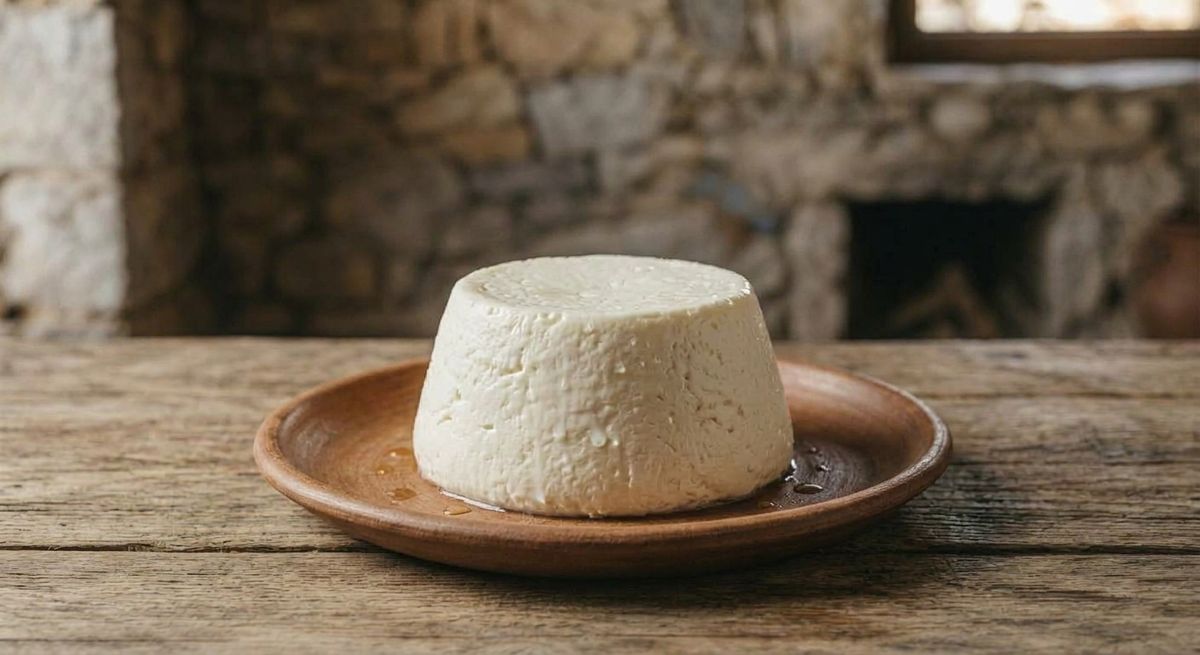
Sweet Myzithra
Μυζήθρα γλυκιά
Say it: mee-ZEE-thra
Soft, fresh and mildly sweet, myzithra is the everyday whey cheese of Crete and the heart of its sweet and savoury pies.
- Made from
- Whey + 3 to 5% milk
- Type
- Fresh whey cheese
- Ripening
- None
- Protection
- Traditional, not PDO
Origin
Where it is made
Made across Crete and the rest of Greece.
West to east. Schematic only, not to scale.
History
The story
Myzithra is made all over Greece from the whey left after making another cheese (“Kritiko tyri,” n.d.). In the Cretan mountains it was, with kefalotyri, one of the two main products of the shepherds' summer (Blitzer, 1990).
“Sweet” (glykia) myzithra is eaten fresh, to tell it apart from the sour xinomyzithra and from dried myzithra used for grating.
Raw material
Milk and proportions
Usually whey from sheep's or goat's milk, which is richer in fat and protein than cow's whey (Pappa & Kondyli, 2023). A small amount of fresh milk, around 3 to 5%, is added during heating (Pappa & Kondyli, 2023), less than in anthotyros.
From milk to cheese
How it is made
Steps follow (Pappa & Kondyli, 2023).
- HeatingFiltered whey is heated; milk is added, then salt.
65 to 75 °C, 1 to 1.5% salt - FlakingFine particles of whey protein appear.
about 80 °C - CookingStirring stops and the curd is held to firm up.
about 90 °C, 20 min - DrainingThe curd is moved to cloth-lined moulds and drains.
3 to 4 hours - ChillingCooled and kept cold; eaten fresh.
about 5 °C
Composition
What is in it
| Moisture | about 65 to 75% |
|---|---|
| Fat | about 3 to 17% |
| pH | about 6.3 to 6.5 |
| Dried myzithra | moisture about 37 to 39%, salt about 9% |
Source (Pappa & Kondyli, 2023).
Legal status
Legislation
| Status | Traditional cheese, not registered as an EU PDO or PGI. |
|---|---|
| Greek Food Code | Classed as a whey cheese, with a legal maximum moisture of 70% (Hellenic Republic, 2020) |
Tasting notes
Look, smell and taste
Look
Snow-white, no rind.
Texture
Soft, moist and grainy, not spreadable (Pappa & Kondyli, 2023).
Aroma
Fresh milk.
Taste
Mild, slightly sweet, lightly salted or unsalted.
At the table
How it is used
In kalitsounia, myzithropites and the Easter tourta of Chania (Cantina, n.d.); warm and fresh with honey; in salads; eaten fresh, often in pies (Pappa & Kondyli, 2023).
At home
How to store it
Very perishable: keep it in the fridge and eat within 3 to 4 days. It can be frozen for use in pies.
Share
Product card
Download a card with the name of the product and a QR code that opens this page.
Take this page with you
Scan the code to open this page on your phone, or visit .
References
- Blitzer, H. (1990). Pastoral life in the mountains of Crete: An ethnoarchaeological perspective. Expedition, 32(3), 34–41.
- Cantina. (n.d.). Tourta Chanion: Mia diaforetiki paschalini pita [Chania tourta: A different Easter pie; In Greek]. https://cantina.protothema.gr/chrisima/themata-chrisima/tourta-chanion-mia-diaforetiki-paschalini-pita/
- Hellenic Republic. (2020). Greek Food and Beverages Code, Article 83: Cheese products [In Greek]. Independent Authority for Public Revenue. https://www.aade.gr/sites/default/files/2020-03/83-iss3.pdf
- Kritiko tyri [Cretan cheese]. (n.d.). In Wikipedia [In Greek]. https://el.wikipedia.org/wiki/Κρητικό_τυρί
- Pappa, E. C., & Kondyli, E. (2023). Descriptive characteristics and cheesemaking technology of Greek cheeses not listed in the EU geographical indications registers. Dairy, 4(1), 43–67. https://doi.org/10.3390/dairy4010003