
 Fresh soft cheese
Pichtogalo Chanion
Πηχτόγαλο Χανίων
Say it: peekh-TO-ga-lo kha-nee-ON
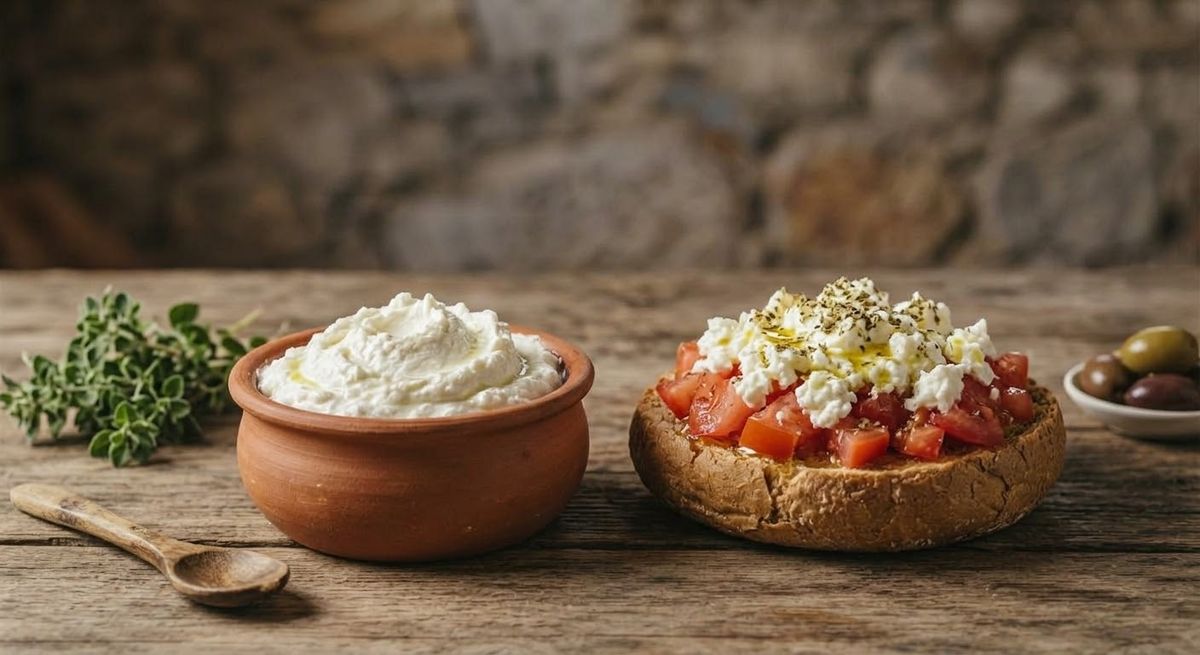
A fresh, creamy and gently sour cheese from Chania, made directly from milk. Its name means “set milk”.
- Milk
- Goat, sheep or both
- Type
- Fresh, soft, spreadable
- Ripening
- None, eaten fresh
- EU PDO since
- 1996
Origin
Where it is made
Pichtogalo Chanion may only be made in the regional unit of Chania, from milk produced there.
West to east. Schematic only, not to scale.
History
The story
Pichtogalo is a “first cheese”: it is made straight from milk, not from whey. It is known locally as myzithra of Chania, and in Rethymno a similar cheese is called anthogalo (Parakentaki, n.d.).
It is the cheese of the famous Chania bougatsa (Greek Gastronomy Guide, n.d.), and all certified production comes from Chania (ELGO-DIMITRA, 2026).
Raw material
Milk and proportions
Goat's milk, sheep's milk or a mixture, from the regional unit of Chania, from traditional breeds fed on local flora, collected at least 10 days after lambing or kidding. Curdling must start within 48 hours of milking. The milk may be fresh or pasteurised; if pasteurised, calcium chloride (up to 20 g per 100 kg of milk) and harmless lactic cultures are allowed (Hellenic Ministry of Agriculture, 1994c; Hellenic Republic, 2020).
From milk to cheese
How it is made
Steps follow (Hellenic Ministry of Agriculture, 1994c).
- SettingThe milk is set slowly with rennet.
about 2 hours - SouringThe curd is left undisturbed for about 24 hours to sour.
- DrainingWithout cutting, the curd is ladled into cloth bags and hung to drain.
- SaltingSalt is added.
about 1% salt - ReadyNo ripening: the cheese is ready to eat once salted.
Composition
What is in it
| Moisture | 65% maximum |
|---|---|
| Fat in dry matter | 50% minimum |
| Typical market samples | moisture 61.6%, fat in dry matter 54.0%, salt 1.0%, pH 4.36 (Papageorgiou et al., 1998) |
Source (Hellenic Republic, 2020).
Protected Designation of Origin
Legislation
| Greek specification | Ministerial Decision 313062/1994 of the Ministry of Agriculture, Government Gazette B 24/18.1.1994 (Hellenic Ministry of Agriculture, 1994c; Hellenic Republic, 2020) |
|---|---|
| EU registration | Commission Regulation (EC) No 1107/96 of 12 June 1996, registered as PDO (European Commission, 1996) |
| Greek Food Code | Article 83, section on PDO cheeses (Hellenic Republic, 2020) |
In numbers
Certified production
Certified PDO Pichtogalo Chanion produced per year, all of Crete (ELGO-DIMITRA, 2026). See all figures.
| Year | Tonnes |
|---|---|
| 2020 | 56.5 t |
| 2021 | 71.6 t |
| 2022 | 53.9 t |
| 2023 | 67.3 t |
| 2024 | 51.7 t |
| 2025 | 60.5 t |
| 2026 (Jan to Aug) | 49.9 t |
Tasting notes
Look, smell and taste
Look
White to off-white, no rind, no holes.
Texture
Soft and spreadable, like thick yogurt.
Aroma
Fresh and milky.
Taste
Light, fresh and slightly sour.
At the table
How it is used
The filling of Chania bougatsa, served warm with sugar (Greek Gastronomy Guide, n.d.); in Sfakian pies and the Chania boureki (Parakentaki, n.d.); spread on rusks with olive oil and oregano; with honey for breakfast.
At home
How to store it
A fresh cheese: keep it in the fridge, covered, and eat it within a few days. Use a clean spoon each time.
Share
Product card
Download a card with the name of the product, the EU PDO logo and a QR code that opens this page.
Take this page with you
Scan the code to open this page on your phone, or visit .
References
- ELGO-DIMITRA. (2026). Diacheirisi stoicheion paragomenon proionton [Data on dairy products produced; Dataset, monthly, 2020 to 2026]. data.gov.gr. https://data.gov.gr/dataset/diacheirisi-stoicheion-paragomenon-proionton
- European Commission. (1996). Commission Regulation (EC) No 1107/96 of 12 June 1996 on the registration of geographical indications and designations of origin under the procedure laid down in Article 17 of Council Regulation (EEC) No 2081/92. Official Journal of the European Communities, L 148, 1–10.
- Greek Gastronomy Guide. (n.d.). Tyria Kritis [Cheeses of Crete; In Greek]. https://www.greekgastronomyguide.gr/item/tyria-kritis/
- Hellenic Ministry of Agriculture. (1994c). Ministerial Decision 313062/1994 recognising the protected designation of origin “Pichtogalo Chanion” [In Greek]. Government Gazette of the Hellenic Republic, B 24/18.1.1994.
- Hellenic Republic. (2020). Greek Food and Beverages Code, Article 83: Cheese products [In Greek]. Independent Authority for Public Revenue. https://www.aade.gr/sites/default/files/2020-03/83-iss3.pdf
- Papageorgiou, D. K., Abrahim, A., Bori, M., & Doundounakis, S. (1998). Chemical and bacteriological characteristics of Pichtogalo Chanion cheese and mesophilic starter cultures for its production. Journal of Food Protection, 61(6), 688–692.
- Parakentaki, E. (n.d.). Ta perifima kritika tyria apo tin archaiotita sto simera [The famous Cretan cheeses from antiquity to today; In Greek]. Cantina. https://cantina.protothema.gr/the-food-bloggers/ta-perifima-kritika-tyria-apo-tin-archa/