
Tyrozouli
Τυροζούλι
Say it: tee-ro-ZOO-lee
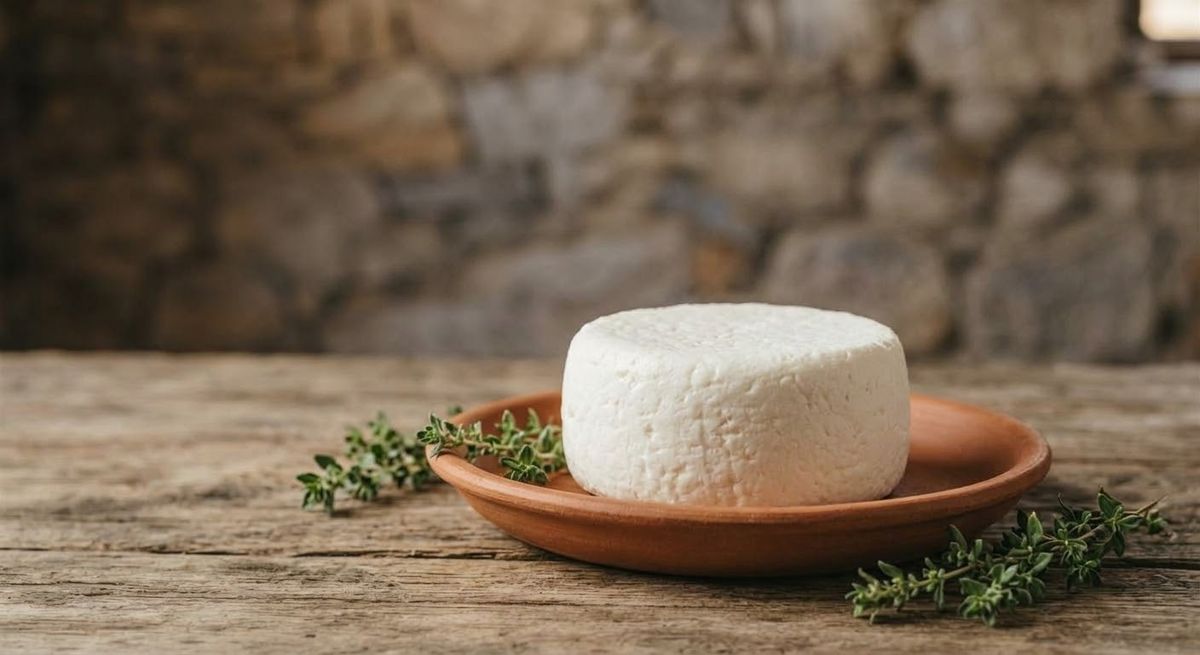
The Cretan “home cheese”: a small cheese made in village kitchens from the milk of the family's own goats or sheep.
- Milk
- Goat or sheep
- Type
- Small, soft to semi-dry
- Ripening
- Eaten fresh or dried
- Protection
- Traditional, not PDO
Origin
Where it is made
A home cheese of village households across Crete, especially in the west.
West to east. Schematic only, not to scale.
History
The story
Tyrozouli is called the “home” cheese (spitiko) because it is still made in homes, from the milk of household animals (Discover Crete, n.d.). It is a traditional cheese of household goat and sheep keeping (“Kritiko tyri,” n.d.).
Instead of rennet it is set with something sour: vinegar, lemon or even fig sap (“Kritiko tyri,” n.d.; Facaros, n.d.-a), a practice as old as Homer.
Raw material
Milk and proportions
Goat's or sheep's milk, or both (Discover Crete, n.d.). The milk is boiled; there is no fixed ratio between the two.
From milk to cheese
How it is made
Steps follow (Discover Crete, n.d.).
- BoilingThe milk is brought to the boil with a little salt, stirring so it does not catch.
- CurdlingAt the first boil, vinegar, lemon juice, a sour starter or fig sap is added, and the milk curdles at once (“Kritiko tyri,” n.d.).
- DrainingThe curd is ladled into small baskets (toupia) lined with cloth and pressed by hand to remove the whey; the whey left in the pot is called choumas (Cheeselovers, n.d.).
one day - SaltingNext day the cheeses are unmoulded and salted well.
- DryingThey are hung, covered with cloth, to dry.
4 to 5 days
Composition
What is in it
| Composition | No published analysis: tyrozouli is mostly home-made and varies from house to house. |
|---|
Legal status
Legislation
| Status | Traditional home cheese, not registered as an EU PDO or PGI. Dairies that sell it must follow the general EU and Greek hygiene rules for cheese (Hellenic Republic, 2020). |
|---|
Tasting notes
Look, smell and taste
Look
Small round cheeses with basket marks.
Texture
Elastic (“Kritiko tyri,” n.d.); stays soft at the heart even when dried (Cheeselovers, n.d.).
Aroma
Fresh boiled milk.
Taste
Mild and milky, lightly salted or unsalted.
At the table
How it is used
Eaten fresh or dry as a table cheese; the fresh cheese fills myzithropites and kalitsounia (Discover Crete, n.d.).
At home
How to store it
Fresh tyrozouli: in the fridge, eaten within a few days. Dried tyrozouli keeps longer in a cool, airy place or the fridge, wrapped in cloth or paper.
Share
Product card
Download a card with the name of the product and a QR code that opens this page.
Take this page with you
Scan the code to open this page on your phone, or visit .
References
- Cheeselovers. (n.d.). Tyrozouli, to xechasmeno tyri tis Kritis [Tyrozouli, the forgotten cheese of Crete; In Greek]. https://cheeselovers.gr/
- Discover Crete. (n.d.). Tyrozouli i kritiko “spitiko” [Tyrozouli, the Cretan “home” cheese; In Greek]. https://www.discovercrete.com/el/content/tyrozouli-or-cretan-home-cheese
- Facaros, D. (n.d.). Tyrozouli. In Greek food decoder. https://www.facarospauls.com/apps/greek-food-decoder/25356/tyrozouli
- Hellenic Republic. (2020). Greek Food and Beverages Code, Article 83: Cheese products [In Greek]. Independent Authority for Public Revenue. https://www.aade.gr/sites/default/files/2020-03/83-iss3.pdf
- Kritiko tyri [Cretan cheese]. (n.d.). In Wikipedia [In Greek]. https://el.wikipedia.org/wiki/Κρητικό_τυρί