
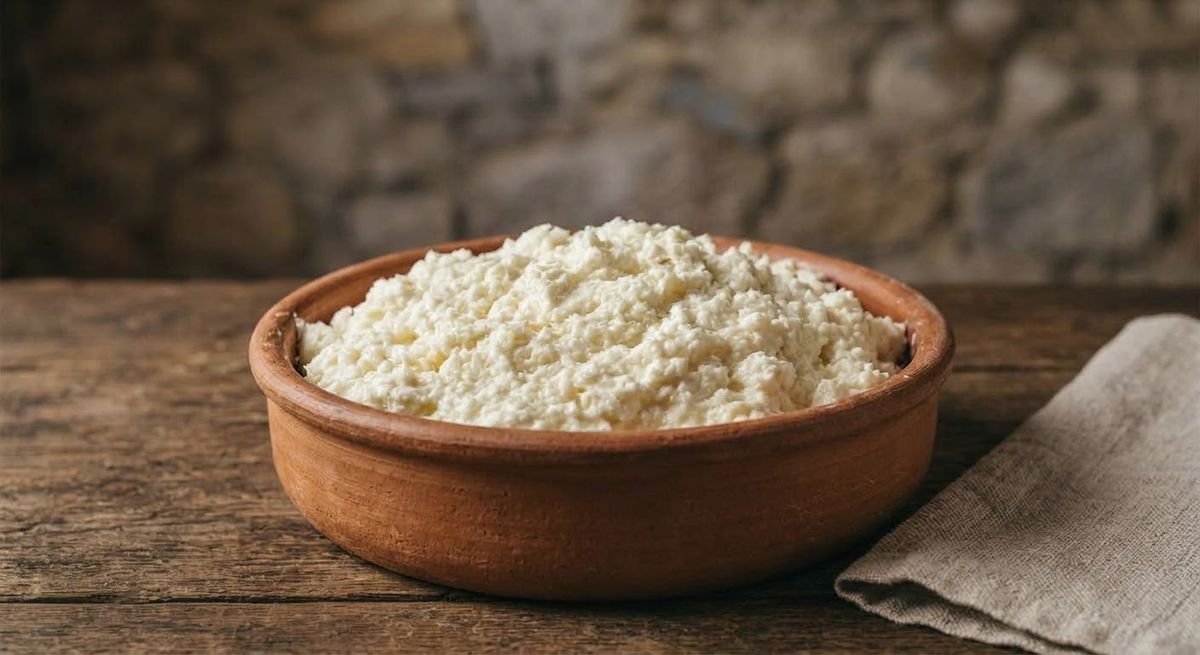
 Soft whey cheese
Xinomyzithra Kritis
Ξινομυζήθρα Κρήτης
Say it: ksee-no-mee-ZEE-thra KREE-tees
A soft, tangy whey cheese, matured in barrels for at least two months. Its name means “sour myzithra”.
- Made from
- Whey, plus up to 15% milk
- Type
- Soft, ripened whey cheese
- Ripening
- 2 months or more
- EU PDO since
- 1996
Origin
Where it is made
Made from whey of milk produced in the four regional units of Crete.
West to east. Schematic only, not to scale.
History
The story
Nothing went to waste in a Cretan dairy. When a hard cheese such as graviera is made, the liquid left behind, the whey, still holds proteins and some fat. Heated again with a little fresh milk, it gives a new cheese. Left to sour and ripen in barrels, that cheese becomes xinomyzithra.
It is one of the four Cretan cheeses protected by the EU. Most of it today comes from Heraklion and Rethymno (ELGO-DIMITRA, 2026).
Raw material
Milk and proportions
Whey from sheep's milk, goat's milk or a mixture, from the four regional units of Crete. Whole sheep's or goat's milk from the area may be added, up to 15%. The milk comes from traditional breeds fed on local flora, collected at least 10 days after lambing or kidding. Whey from other milk types, milk powder, milk proteins, caseinates, colourings, preservatives and antibiotics are prohibited (Hellenic Ministry of Agriculture, 1994b; Hellenic Republic, 2020).
From milk to cheese
How it is made
Steps follow (Hellenic Ministry of Agriculture, 1994b; Hellenic Republic, 2020).
- FilteringThe whey is filtered or centrifuged to remove fine curd particles.
- Heating and adding milkThe whey is heated with stirring; whole sheep's or goat's milk (up to 15%) is added.
68 to 70 °C - FlakingStirring continues until the whey proteins rise as flakes, then heating continues faster.
about 80 °C, then up to 92 °C - Resting and drainingThe curd rests about 30 minutes, is moved to moulds and drains for 3 to 5 hours.
- SaltingSalt is mixed in carefully.
1.5 to 2.0% salt - SouringThe curd is pressed in cloth bags for about a week, while its acidity rises.
- Barrel ripeningPacked into barrels without air pockets and ripened for at least two months.
below 10 °C
Composition
What is in it
| Moisture | 55% maximum |
|---|---|
| Fat in dry matter | 45% minimum |
| Additives | Colourings, preservatives and antibiotics prohibited |
Source (Hellenic Republic, 2020).
Protected Designation of Origin
Legislation
| Greek specification | Ministerial Decision 313051/1994 of the Ministry of Agriculture, Government Gazette B 18/14.1.1994 and B 101/16.2.1994 (Hellenic Ministry of Agriculture, 1994b; Hellenic Republic, 2020) |
|---|---|
| EU registration | Commission Regulation (EC) No 1107/96 of 12 June 1996, registered as PDO “Xynomyzithra Kritis” (European Commission, 1996) |
| Greek Food Code | Article 83, section on PDO cheeses (Hellenic Republic, 2020) |
In numbers
Certified production
Certified PDO Xinomyzithra Kritis produced per year, all of Crete (ELGO-DIMITRA, 2026). See all figures.
| Year | Tonnes |
|---|---|
| 2020 | 155 t |
| 2021 | 278 t |
| 2022 | 175 t |
| 2023 | 281 t |
| 2024 | 193 t |
| 2025 | 282 t |
| 2026 (Jan to Aug) | 214 t |
Tasting notes
Look, smell and taste
Look
White to off-white, no rind, no holes.
Texture
Soft, grainy to creamy.
Aroma
Fresh, milky and lactic.
Taste
Pleasantly sour and slightly salty, with a sweet milky finish.
At the table
How it is used
Spread on bread or barley rusks with olive oil; in sweet and savoury pies, including the Easter tourta of Chania, which combines several fresh cheeses with lamb (Cantina, n.d.); with honey as a dessert; in kalitsounia.
At home
How to store it
Keep refrigerated in its container, covered, and use within a few days of opening. Always use a clean spoon. Under Greek law, ripened soft cheeses are kept at 0 to 20 °C until sale (Hellenic Republic, 2020), but at home the fridge is best.
Share
Product card
Download a card with the name of the product, the EU PDO logo and a QR code that opens this page.
Take this page with you
Scan the code to open this page on your phone, or visit .
References
- Cantina. (n.d.). Tourta Chanion: Mia diaforetiki paschalini pita [Chania tourta: A different Easter pie; In Greek]. https://cantina.protothema.gr/chrisima/themata-chrisima/tourta-chanion-mia-diaforetiki-paschalini-pita/
- ELGO-DIMITRA. (2026). Diacheirisi stoicheion paragomenon proionton [Data on dairy products produced; Dataset, monthly, 2020 to 2026]. data.gov.gr. https://data.gov.gr/dataset/diacheirisi-stoicheion-paragomenon-proionton
- European Commission. (1996). Commission Regulation (EC) No 1107/96 of 12 June 1996 on the registration of geographical indications and designations of origin under the procedure laid down in Article 17 of Council Regulation (EEC) No 2081/92. Official Journal of the European Communities, L 148, 1–10.
- Hellenic Ministry of Agriculture. (1994b). Ministerial Decision 313051/1994 recognising the protected designation of origin “Xynomyzithra Kritis” [In Greek]. Government Gazette of the Hellenic Republic, B 18/14.1.1994 and B 101/16.2.1994.
- Hellenic Republic. (2020). Greek Food and Beverages Code, Article 83: Cheese products [In Greek]. Independent Authority for Public Revenue. https://www.aade.gr/sites/default/files/2020-03/83-iss3.pdf