
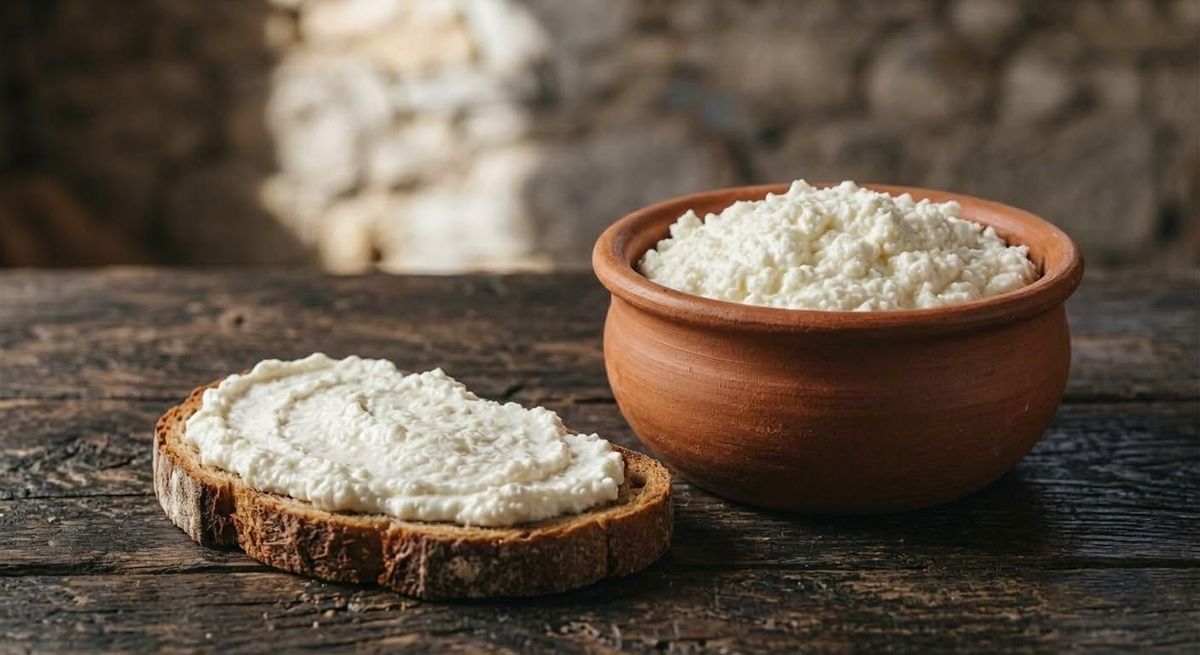
 Soft, spreadable
Xygalo Siteias
Ξύγαλο Σητείας
Say it: KSEE-ga-lo see-TEE-as
A soft, spreadable, gently sour cheese from Sitia in eastern Crete. Its name comes from the ancient Greek oxygala, sour milk.
- Milk
- Goat, or goat and sheep
- Type
- Soft, acid-set, spreadable
- Ripening
- About 1 month
- EU PDO since
- 2011
Origin
Where it is made
Xygalo Siteias may only be made in the municipalities of Sitia, Makry Gialos, Itanos and Lefki in eastern Crete.
West to east. Schematic only, not to scale.
History
The story
Sitia has the driest, sunniest climate on Crete and more than 700 plant species, dominated by aromatic shrubs such as sage and thyme. Minoan pierced clay vessels for draining curd have been found at nearby Palaikastro, and records from 1347 to 1450 describe cheese shipped from the port of Sitia to Venice, Egypt and Cyprus (European Commission, 2011).
Traditionally xygalo was made in summer in the mountain mitata, in clay pots with a hole near the base for draining the whey. It was first described in writing in 1957 (European Commission, 2011). Its name links it to the ancient oxygala (Lapidakis & Fragkiadakis, 2022).
Raw material
Milk and proportions
Raw milk from healthy goats and sheep raised traditionally in the area. Goats must be of indigenous Greek breeds; sheep are mainly of the Sitia breed, with the Psiloritis and Sfakia breeds and their crosses. Sheep's milk is added when there is not enough goat's milk, and its fat is then adjusted so that the cheese does not exceed 46% fat in dry matter (European Commission, 2011).
From milk to cheese
How it is made
Steps follow (European Commission, 2011).
- Optional pasteurisationThe milk may be pasteurised, then cooled.
25 °C - Salting the milkSalt is dissolved in the milk before souring, with lactic cultures and a little natural animal rennet.
up to 2% salt - Natural souringThe milk sours for 7 to 10 days in covered but not airtight containers. The curd is never stirred.
15 to 20 °C - SkimmingExcess fat and cream are removed from the surface.
- RipeningThe cheese ripens for about a month in the same containers, then the whey collected at the bottom is removed.
10 to 15 °C - CoolingThe cheese is chilled. If the milk was not pasteurised, it is kept cold for at least 2 months before sale.
below 4 °C
Composition
What is in it
| Moisture | 75% maximum |
|---|---|
| Fat in dry matter | 33 to 46% |
| Salt | 1.5% maximum |
| Packaging | Up to 5 kg, packed within the area; shelf life up to 6 months |
Source (European Commission, 2011).
Protected Designation of Origin
Legislation
| EU registration | Commission Implementing Regulation (EU) No 766/2011, registered as PDO; single document in Official Journal C 312 of 17 November 2010 (European Commission, 2011) |
|---|---|
| Label | Cheese made from unpasteurised milk must state that it is made with raw milk (European Parliament & Council, 2004) |
In numbers
Certified production
Certified PDO Xygalo Siteias produced per year, all of Crete (ELGO-DIMITRA, 2026). See all figures.
| Year | Tonnes |
|---|---|
| 2020 | 72.7 t |
| 2021 | 49.7 t |
| 2022 | 92.7 t |
| 2023 | 116 t |
| 2024 | 116 t |
| 2025 | 111 t |
| 2026 (Jan to Aug) | 162 t |
Tasting notes
Look, smell and taste
Look
White, with no rind.
Texture
Soft, pasty or slightly grainy, spreadable.
Aroma
Fresh, lactic, with a light goat note.
Taste
Fresh and gently sour (European Commission, 2011).
At the table
How it is used
Spread on barley rusks or bread with olive oil; on dakos with tomato; as a dip with raw vegetables; in pies.
At home
How to store it
Keep at or below 4 °C, covered. Use a clean spoon each time and eat within a few days of opening.
Share
Product card
Download a card with the name of the product, the EU PDO logo and a QR code that opens this page.
Take this page with you
Scan the code to open this page on your phone, or visit .
References
- ELGO-DIMITRA. (2026). Diacheirisi stoicheion paragomenon proionton [Data on dairy products produced; Dataset, monthly, 2020 to 2026]. data.gov.gr. https://data.gov.gr/dataset/diacheirisi-stoicheion-paragomenon-proionton
- European Commission. (2011). Commission Implementing Regulation (EU) No 766/2011 entering a name in the register of protected designations of origin and protected geographical indications [Xygalo Siteias (PDO)], with single document published in Official Journal of the European Union, C 312, 17.11.2010.
- European Parliament & Council of the European Union. (2004). Regulation (EC) No 853/2004 laying down specific hygiene rules for food of animal origin. Official Journal of the European Union, L 139.
- Lapidakis, N., & Fragkiadakis, G. A. (2022). Dairy processing: The soft spreadable cheese Xygalo Siteias. Processes, 10(1), 80. https://doi.org/10.3390/pr10010080