TraditionalFresh milk cheese
Galomyzithra
Γαλομυζήθρα
Say it: ga-lo-mee-ZEE-thra
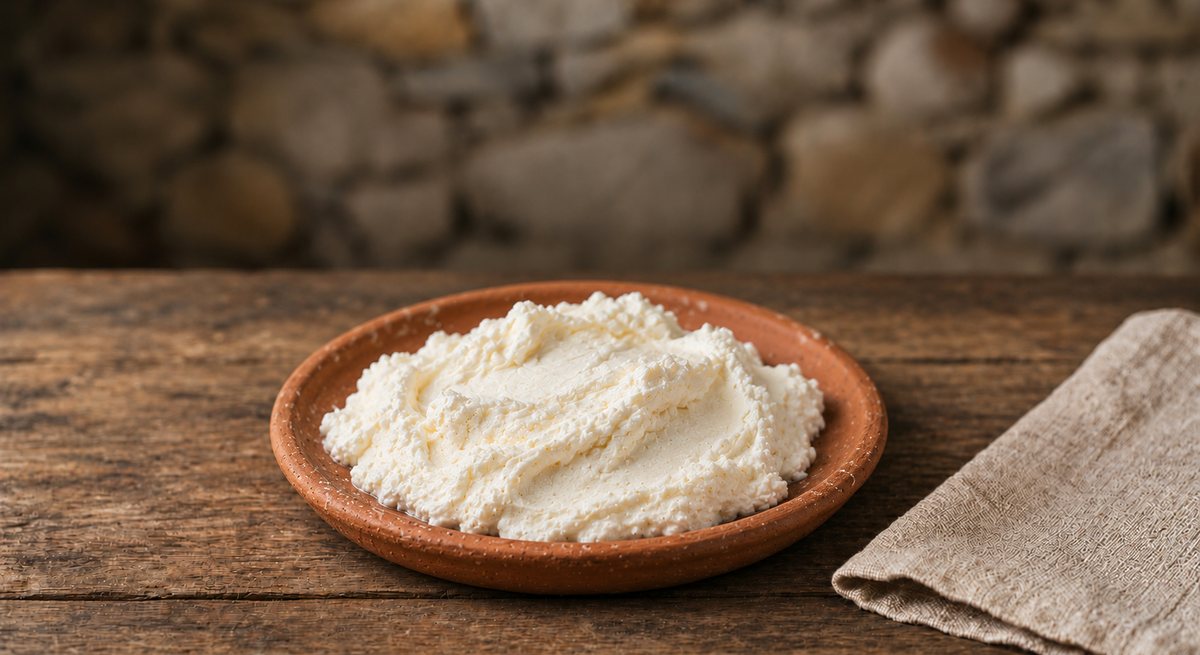
A soft, white, gently sour cheese made straight from whole milk, not from whey: the everyday spoon cheese of western Crete.
- Milk
- Sheep, goat or both
- Type
- Fresh, soft, acid-set
- Ripening
- None
- Protection
- Traditional, not PDO
Origin
Where it is made
Made in homes and small dairies, above all in western Crete.
Chania
Rethymno
Heraklion
Lasithi
West to east. Schematic only, not to scale.
History
The story
Despite its name, galomyzithra is not a whey cheese like myzithra. It is a “milk myzithra”: whole milk is left to turn and set by natural souring, then drained (Cooklos, n.d.). It is a very old, simple kind of cheesemaking, still done mostly at home rather than in dairies (Cheeselovers, n.d.-b).
Its texture and taste are close to the myzithra of Chania and to xinomyzithra: soft, with a gentle sourness (Destination Crete, n.d.). In Chania the same kind of cheese is also called pichtogalo (Kritika Epikaira, n.d.); only cheese made in the Chania regional unit to the PDO specification may be sold as Pichtogalo Chanion PDO (see that page).
Raw material
Milk and proportions
Whole milk only: sheep's, goat's or a mixture. No whey is used (Cooklos, n.d.; Kritika Epikaira, n.d.). There is no fixed ratio between sheep's and goat's milk.
From milk to cheese
How it is made
SouringFresh whole milk is left at room temperature to sour and set (it “turns”) by natural acidification (Cooklos, n.d.).
DrainingThe soft curd is ladled into cloth bags or moulds and left to drain.
SaltingIt is salted lightly and chilled.
Composition
What is in it
| Composition | No peer-reviewed analysis has been published. As a fresh, unripened soft cheese it must meet the Greek Food Code limits for fresh cheeses, with a legal maximum moisture of 75% (Hellenic Republic, 2020). |
|---|
Legal status
Legislation
| Status | Traditional cheese, not registered as an EU PDO or PGI. |
|---|
| Greek Food Code | A cheese from milk without ripening, eaten fresh (Hellenic Republic, 2020). |
|---|
| Name | Made in Chania to the PDO rules, the same type of cheese is sold as Pichtogalo Chanion PDO (Hellenic Ministry of Agriculture, 1994c). |
|---|
Tasting notes
Look, smell and taste
Look
Snow-white, soft, without rind.
Texture
Soft and creamy, like thick yogurt.
Taste
Mild with a gentle sourness (Destination Crete, n.d.).
At the table
How it is used
On barley rusks for dakos (Cooklos, n.d.); spread on warm bread with olive oil and oregano; in kalitsounia and other cheese pies.
Cook with it
Recipes
All recipes →
Traditional home recipes; quantities are indicative and vary from house to house.
Dakos with Galomyzithra
Serves 210 minutesStarter
Ingredients
- 2 barley rusks Crete
- 2 ripe tomatoes, grated
- 150 g Galomyzithra Crete
- 4 tbsp extra virgin olive oil Crete
- dried oregano, salt, olives
Method
- Moisten the rusks with a little water.
- Cover with grated tomato and season.
- Add spoonfuls of Galomyzithra, olives and oregano and finish with olive oil.
Savoury kalitsounia with Galomyzithra
about 30 pieces1 hour 15 minutesPastry
Ingredients
- Olive oil dough: 500 g flour, 120 ml extra virgin olive oil, 200 ml water, 1 tsp salt
- 500 g Galomyzithra, drained Crete
- 1 egg
- 2 tbsp chopped mint
- sesame, to finish
Method
- Knead the dough and rest it for 30 minutes.
- Mix the Galomyzithra with the egg and mint.
- Cut 8 to 10 cm circles, fill and pinch into open cups.
- Sprinkle with sesame and bake at 180 °C for 25 to 30 minutes.
Warm bread with Galomyzithra, olive oil and oregano
Serves 25 minutesBreakfast
Ingredients
- 4 thick slices of village bread
- 150 g Galomyzithra Crete
- 3 tbsp extra virgin olive oil Crete
- dried oregano or thyme Crete
Method
- Toast the bread over a flame or in a pan.
- Spread thickly with Galomyzithra while still warm.
- Drizzle with olive oil and sprinkle with oregano.
At home
How to store it
A fresh cheese: keep it covered in the fridge, use a clean spoon each time and eat it within a few days.
Share
Product card
Download a card with the name of the product and a QR code that opens this page.
Take this page with you
Scan the code to open this page on your phone, or visit .
References
- Cheeselovers. (n.d.). Galomyzithra [In Greek]. https://www.cheeselovers.gr/tyria-tou-kosmou/cheese/451-γαλομυζήθρα.html
- Cooklos. (n.d.). I paraskevi tis galomyzithras [How galomyzithra is made; In Greek]. https://www.cooklos.gr/ayto-to-ikseres/paraskeyi-galomyzithras
- Destination Crete. (n.d.). Cretan cheese. https://www.destinationcrete.gr/crete-gastronomy/cretan-cheese/
- Hellenic Ministry of Agriculture. (1994c). Ministerial Decision 313062/1994 recognising the protected designation of origin “Pichtogalo Chanion” [In Greek]. Government Gazette of the Hellenic Republic, B 24/18.1.1994.
- Hellenic Republic. (2020). Greek Food and Beverages Code, Article 83: Cheese products [In Greek]. Independent Authority for Public Revenue. https://www.aade.gr/sites/default/files/2020-03/83-iss3.pdf
- Kritika Epikaira. (n.d.). Galomyzithra gia polles chriseis [Galomyzithra for many uses; In Greek]. http://www.kritikaepikaira.gr/