
Tasting
How to taste Cretan cheese
Cretan cheese is made mostly from the milk of sheep and goats that graze on the island's mountains. To taste what makes each one different, you need only a few simple habits: the right temperature, a fixed order, and a moment of attention for each piece. This guide shows how, whether you are at home, at a taverna or setting up a hotel buffet.
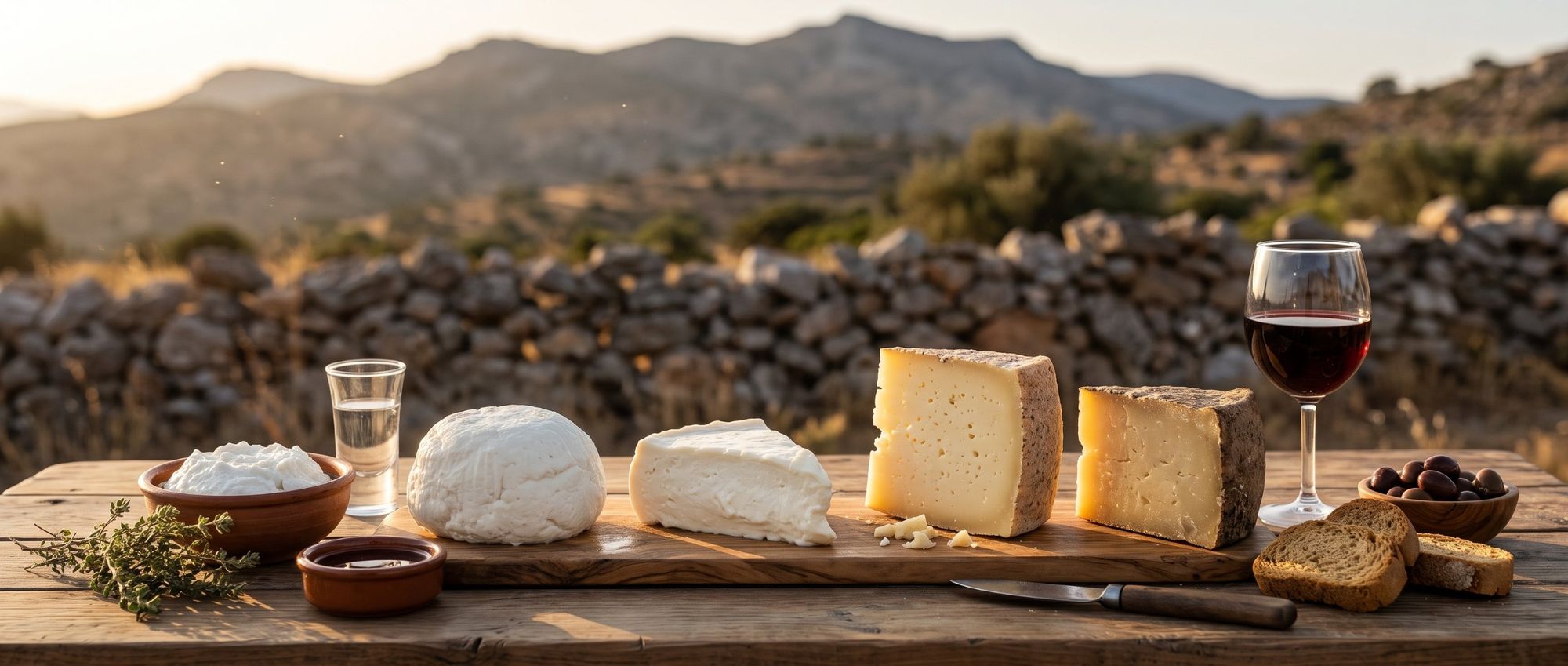
Before you start
Most of what you taste is decided before the first bite. Cheese straight from the fridge is closed and dull: the cold holds back its aroma and tightens its texture. Too warm, and it turns oily and loses its shape.
- Hard and aged cheeses (graviera, kefalotyri, dry anthotyros): take them out of the fridge about 45 to 60 minutes before tasting, still wrapped.
- Soft and fresh cheeses (myzithra, galomyzithra, pichtogalo, xygalo, malaka): 15 to 20 minutes are enough. They should be cool, not cold.
- Cheese in brine (Cretan white cheese): lift it out, let it drain for a few minutes and pat it dry, so you taste the cheese and not only the brine.
- Yogurt and staka: serve yogurt chilled; staka tastes best at room temperature, or gently warmed.
- Cut just before you taste, not hours ahead, so the edges do not dry. Cut pieces of similar size, and for hard cheeses include a little of the outer part and a little of the centre.
- Have water and plain bread or a plain barley rusk at hand, to clear your mouth between cheeses. Taste in daylight if you can, away from strong smells.
(Cheese Tasting and Sensory Evaluation Guide)
The five steps
Taste every cheese in the same order of steps. It sounds formal, but it is what lets you notice the differences between one cheese and the next.
- 1
Look
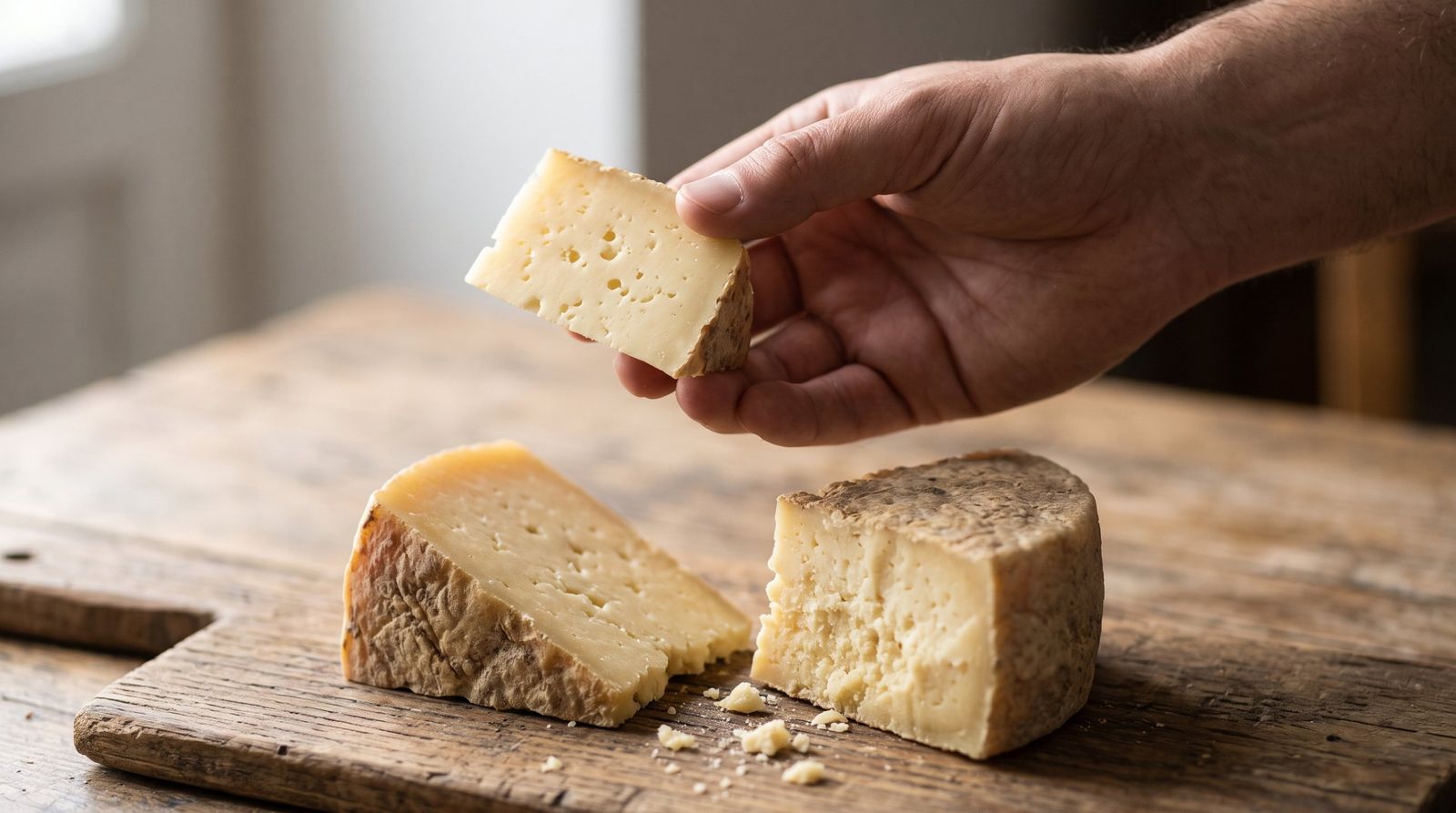
Colour, surface, holes. A fresh Cretan cheese is pure white; graviera turns from pale ivory to straw yellow as it ages, and may show small round holes, the result of the bacteria that ripen it. Look also at the cut: is it smooth, crumbly, moist?
- 2
Smell
Smell once lightly, then once more slowly. Fresh cheeses smell of milk, yogurt or butter; aged ones of nuts, browned butter, sometimes of dry herbs. Smell the cheese again after breaking it: the inside often smells different from the surface.
- 3
Touch
Press, bend and break a piece with your fingers, then notice how it feels in the mouth: creamy, elastic, firm, grainy, dry. Malaka bends and stretches; aged graviera breaks with a clean, slightly grainy edge.
- 4
Taste
Let the piece warm on your tongue and follow the tastes in order: first salt and sourness, which arrive at once; then sweetness and any bitterness; last the deep, savoury taste of a mature cheese. Ask whether they sit together in balance or one covers the rest.
- 5
Finish
After you swallow, wait a few seconds. What stays, and for how long? A good aged graviera leaves a long, sweet and nutty finish; a fresh myzithra a short, clean, milky one. Both are right for what they are.
(Cheese Tasting and Sensory Evaluation Guide)
In what order
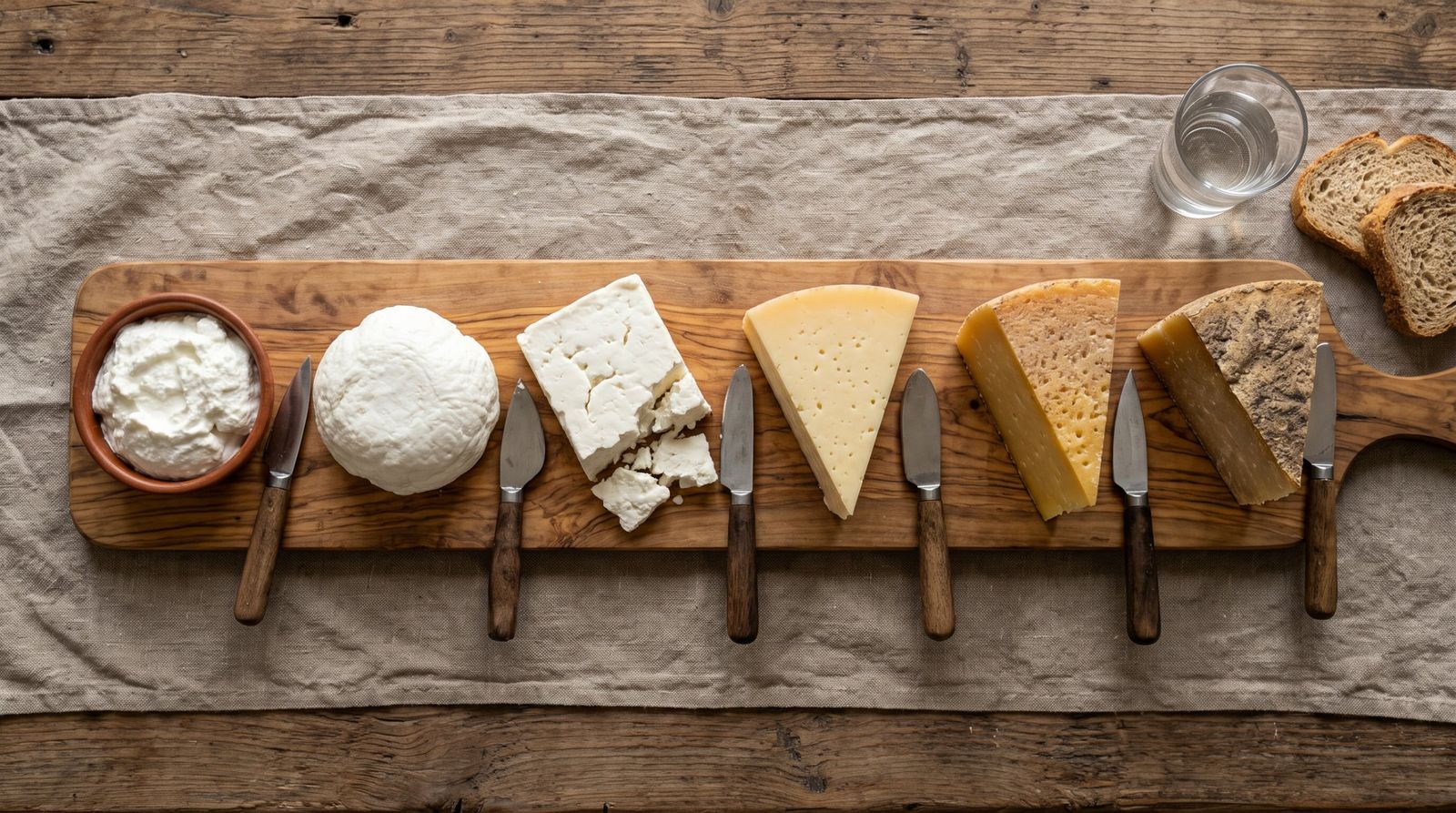
Go from mild to strong, from fresh to aged, and from less salty to more salty. A strong cheese tasted early covers the delicate ones that follow. A good order for a full Cretan tasting:
- Sweet myzithra mild, milky, barely salted
- Malaka fresh, elastic curd, mild
- Galomyzithra soft, gently sour
- Pichtogalo Chanion creamy, clean lactic sourness
- Xygalo Siteias spreadable, more sour
- Tyrozouli home cheese, different in every house
- Cretan white cheese salty and tangy from the brine
- Xinomyzithra Kritis tangy, salty, matured two months
- Graviera Kritis, young then aged sweet and nutty, deeper with age
- Kefalotyri Kritis hard, salty, sharp
- Dry anthotyros firm and savoury; taste thin shavings
- Staka rich and tangy; a little on bread, at the end
You do not need all twelve. Three to five cheeses make a good tasting: for example myzithra, pichtogalo or xygalo, xinomyzithra, graviera and kefalotyri. Yogurt is best tasted on its own, sheep's next to goat's, to compare the richer sheep's milk with the lighter, fresher goat's.
What to notice in each cheese
- Γραβιέρα Κρήτης Graviera Kritis
- Pale ivory when young, straw yellow when aged, often with small round holes. Sweet and nutty; with age it becomes firmer, deeper and more savoury. Researchers have found in Graviera Kritis aromatic compounds of the same kind as in the plants the flocks graze, and the island's graviera can be told apart from others in the laboratory. Taste a young and an aged one side by side. (Small Ruminant Research, 2016; Ralli and Spyros, 2023)
- Κεφαλοτύρι Κρήτης Kefalotyri Kritis
- Hard, salty and sharp, with a stronger bite than graviera. Notice how the salt arrives first and the savoury taste stays long after. Take small pieces.
- Ξυνομυζήθρα Κρήτης Xinomyzithra Kritis
- A whey cheese matured in barrels for at least two months. Soft to slightly crumbly, white, tangy and salty. Notice the clean sourness and how it softens on the tongue.
- Πηχτόγαλο Χανίων Pichtogalo Chanion
- Fresh, moist and creamy, with a gentle, clean sourness, like a thick yogurt that holds its shape. Studies of traditional Pichtogalo describe a very moist cheese with low salt and a sour pH. Taste it with a spoon. (Papageorgiou et al., 1998)
- Ξύγαλο Σητείας Xygalo Siteias
- Soft and spreadable, gently to clearly sour, from Sitia in eastern Crete. Spread a little on a rusk and notice the fresh, slightly sharp finish.
- Μυζήθρα γλυκιά Sweet myzithra
- Soft, white, mildly sweet and barely salted: the gentlest taste of the tasting. Notice the milky sweetness and the short, clean finish. Try a spoonful with a drop of thyme honey.
- Γαλομυζήθρα Galomyzithra
- Made from whole milk, not whey: soft, white and gently sour, the everyday spoon cheese of western Crete. Compare it with sweet myzithra to taste the difference between a milk cheese and a whey cheese.
- Ξηρός ανθότυρος Dry anthotyros
- Salted and dried until firm. Taste it in thin shavings: it is savoury and salty, with a milky sweetness underneath. It shows what drying does to a whey cheese.
- Μαλάκα Malaka
- The fresh curd of graviera before it is salted and ripened. Elastic and mild; pull a piece apart and notice how it stretches. Taste it next to an aged graviera to see what ripening adds.
- Τυροζούλι Tyrozouli
- The village home cheese, made in small quantities from a family's own animals. No two are the same: ask where it comes from, and taste it as a portrait of one house and one flock.
- Λευκό τυρί Κρήτης Cretan white cheese
- Ripened and kept in brine, salty and tangy. Drain it first. Notice the texture, from firm to creamy, and how the saltiness softens when you eat it with ripe tomato and olive oil.
- Στάκα Staka
- Crete's sour cream, the rich layer that rises on sheep's and goat's milk. Taste a little on bread, at the end: buttery, tangy and very rich. Its golden butter, stakovoutyro, is for cooking rather than tasting.
What to pair it with
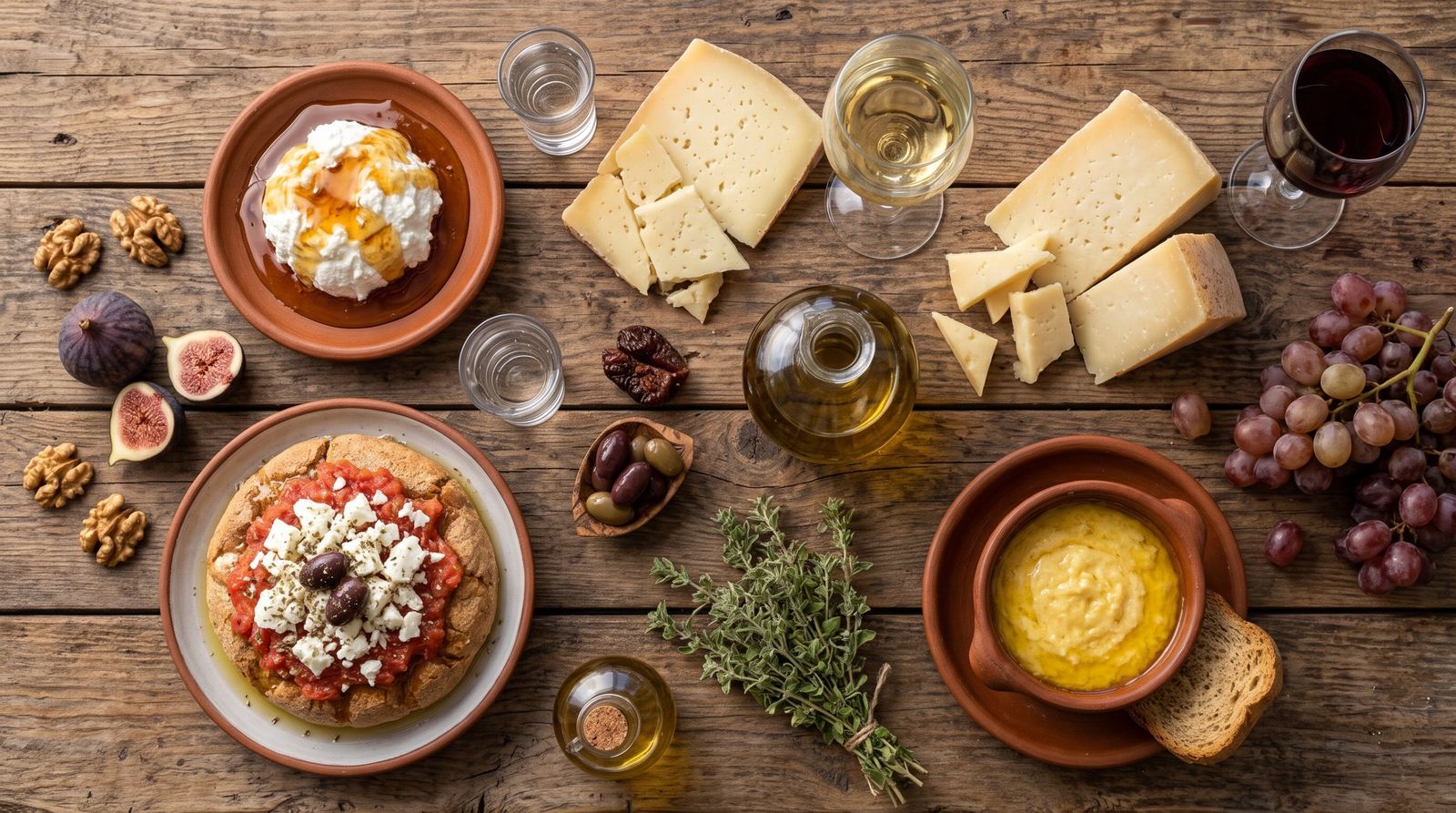
Cretan cheese has always been eaten with what grows around it. A few combinations that work, and why:
- Fresh, sweet cheeses (myzithra, malaka)
- Thyme honey, figs, grapes, a crisp white wine such as Vilana or Vidiano. The honey brings out their milky sweetness.
- Sour, spreadable cheeses (pichtogalo, xygalo, galomyzithra)
- Barley rusks, ripe tomato, olive oil, olives, wild greens. A fresh white or rosé. The sourness cuts through the oil.
- Salty, tangy cheeses (xinomyzithra, white cheese)
- Tomato and olive oil on a rusk, the Cretan dakos; cucumber; a white Thrapsathiri or Vidiano.
- Graviera
- Young graviera with a fuller white such as Vidiano; aged graviera with a red from Liatiko or Kotsifali and Mandilari, or with a sweet Malvasia. Walnuts and thyme honey suit both.
- Kefalotyri and dry anthotyros
- A glass of tsikoudia (raki), olives, cured meats. Strong, salty cheese and clear spirit are the classic Cretan meze.
- Staka
- Warm bread, or fried eggs cooked in it, the way it is eaten in Crete. A red wine or tsikoudia.
A good rule: drink what is made near the cheese. Wines are a suggestion, not a rule; trust your own taste.
Words to describe what you taste
Using the same words each time makes it easier to compare cheeses and to remember them.
| Texture | creamy, moist, spreadable, elastic, crumbly, firm, grainy, dry |
|---|---|
| Aroma | fresh milk, yogurt, butter, cream, nuts, browned butter, dry herbs, hay |
| Taste | salty, sour or tangy, sweet, bitter, savoury, sharp |
| Finish | short, long, clean, sweet, salty, lingering |
Setting up a tasting at home, in a taverna or at a hotel
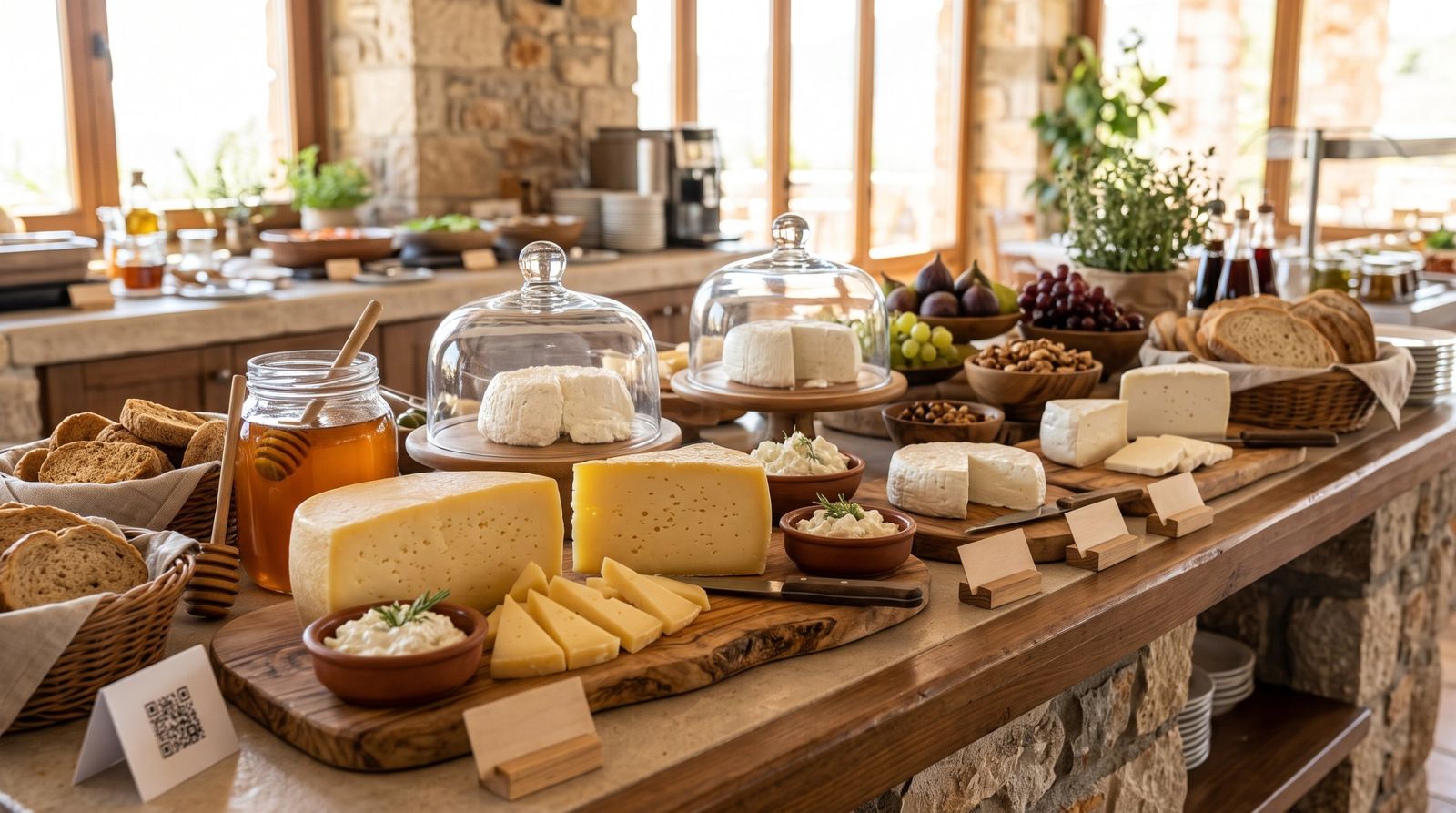
- Choose three to five cheeses of different kinds: one fresh, one sour, one whey cheese, one or two aged.
- Count about 25 to 30 g of each cheese per person for a tasting, or about 100 g in total per person when cheese is the main part of the meal.
- Lay the cheeses out in tasting order, from mild to strong, clockwise on a round board or left to right on a long one.
- Use a separate knife or spoon for each cheese, so that flavours do not mix.
- Put a small sign with the name of each cheese. Guests remember a cheese when they know its name and where it comes from.
- On a buffet, keep fresh cheeses, yogurt and staka chilled and bring out small amounts at a time; follow your food safety (HACCP) plan for how long chilled food may stay out.
Hotels and restaurants can download free QR signs that open the page of each cheese in the guest's language: see Hotels & Restaurants.
Common mistakes
- Serving cheese straight from the fridge.
- Starting with the strongest cheese: after kefalotyri you will hardly taste myzithra.
- Cutting everything hours in advance, so the edges dry and the aroma fades.
- Tasting with a strongly flavoured bread, or with a heavy wine that covers fresh cheeses.
- Talking about a cheese before everyone has tasted it: let each person form an opinion first.
- Calling a strong taste a fault. A sharp kefalotyri or a sour xygalo is meant to be so; a fault is a taste that does not belong to the cheese, such as bitterness that grows, or a smell of ammonia.
(Cheese Tasting and Sensory Evaluation Guide)
Find recipes with each cheese on the recipes page, and the people who make them on the producers page.
How cheese was made before steel vats and fridges, and what science says about it: The old ways.
References
- Cheese Tasting and Sensory Evaluation Guide: setting up a tasting, the five steps, the flavour sequence and common mistakes. Project reference library (BONUS 05).
- Graviera Naxou and Graviera Kritis: discrimination based on microbiological and physicochemical criteria and volatile profile. Small Ruminant Research 136 (2016): 161–172.
- Ralli, E. and Spyros, A. (2023). A study of Greek graviera cheese by NMR-based metabolomics. Molecules 28(14): 5488. doi:10.3390/molecules28145488
- Papageorgiou, D.K., Abrahim, A., Bori, M. and Doundounakis, S. (1998). Chemical and bacteriological characteristics of Pichtogalo Chanion cheese. Journal of Food Protection 61: 688–692.
- Product pages of this site, for the description of each cheese.