TraditionalWhite brined cheese
Cretan White Cheese
Λευκό τυρί Κρήτης
Say it: lef-KO tee-REE KREE-tees
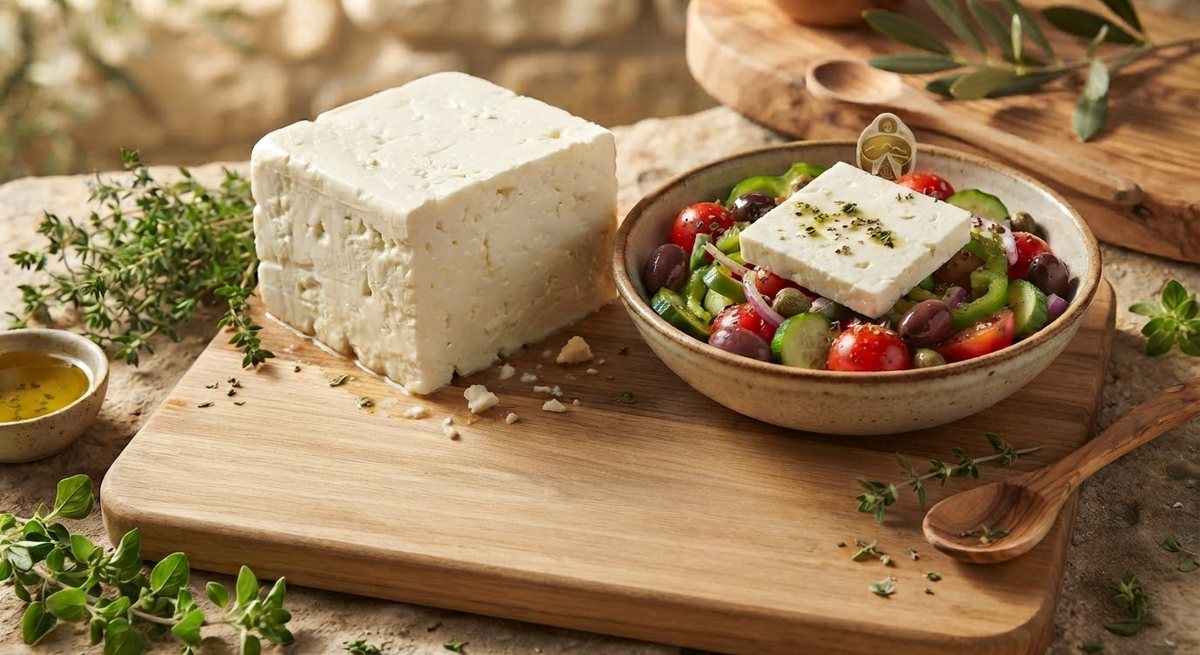
A white cheese ripened and kept in brine, made in Crete from sheep's and goat's milk. It is made like feta, but by law it cannot carry that name.
- Milk
- Sheep and goat
- Type
- Soft, white, brined
- Ripening
- At least 15 days in brine
- Protection
- Not PDO; cannot be called feta
Origin
Where it is made
Made across Crete. It may not be called feta, because Crete lies outside the feta PDO area.
Chania
Rethymno
Heraklion
Lasithi
West to east. Schematic only, not to scale.
History
The story
Feta is an EU protected designation of origin, and the name may only be used for white brined cheese made in Macedonia, Thrace, Epirus, Thessaly, Central Greece, the Peloponnese and Lesvos (European Commission, 2002; Hellenic Ministry of Agriculture, 1994d). Crete is not in that area.
Cretan dairies therefore sell their white brined cheese as “white cheese” (lefko tyri), the general legal name in Greece for cheeses of this type (Hellenic Republic, 2020). It is the cheese of the Cretan salad and of many home pies.
Raw material
Milk and proportions
Sheep's and goat's milk, in proportions that vary from dairy to dairy. Greek law allows white brined cheeses to be made from the milk of cows, sheep, goats or buffalo, raw or pasteurised, or mixtures (Hellenic Republic, 2020); the label must state the kind of milk and whether it was pasteurised (Hellenic Republic, 2020). (Feta, for comparison, must be sheep's milk with up to 30% goat's milk (Hellenic Ministry of Agriculture, 1994d).)
From milk to cheese
How it is made
Steps follow (Dairy technology training notes, n.d.), which describe the typical method for Greek white brined cheese.
PasteurisingThe milk is pasteurised; lactic starter and rennet are added.
72 °C for 15 s; set at about 35 °C
CuttingThe curd is cut about an hour after renneting.
Moulding and saltingThe curd is placed in moulds, turned and dry-salted, then cut into blocks.
16 to 18 °C
BriningThe blocks are packed in tins or barrels and covered with brine until the pH falls to about 4.4 to 4.6.
7.5% brine, 16 to 18 °C
Cold ripeningThe cheese is moved to the cold room to finish ripening.
about 4 °C
Composition
What is in it
| Legal minimum ripening | 15 days in brine from pasteurised milk; 2 months from raw milk (Hellenic Republic, 2020) |
|---|
| First quality | moisture 56% maximum, fat in dry matter 43% minimum (Hellenic Republic, 2020) |
|---|
| Second quality | moisture 58% maximum, fat in dry matter 40% minimum (Hellenic Republic, 2020) |
|---|
| Third quality | moisture 58% maximum, fat in dry matter 35% minimum (Hellenic Republic, 2020) |
|---|
Legal status
Legislation
| Status | Not registered as an EU PDO or PGI. |
|---|
| Name | Cannot be sold as “feta”: that name is an EU PDO reserved for cheese from the defined mainland areas and Lesvos (European Commission, 2002). |
|---|
| Greek Food Code | Classed as a white brined cheese: soft cheese ripened and kept in brine, sold in wooden, plastic or metal containers or barrels (Hellenic Republic, 2020). |
|---|
| Storage | Soft cheeses are stored at 0 to 20 °C until sale (Hellenic Republic, 2020). |
|---|
Tasting notes
Look, smell and taste
Look
Pure white, no rind, a few small openings.
Texture
Firm but soft, crumbles when cut.
Aroma
Clean, lactic, with a note of sheep's milk.
Taste
Salty and slightly sour, rich with sheep's milk.
At the table
How it is used
In the Cretan salad and village salad; baked with tomato and peppers; in pies with wild greens; on its own with olives, bread and olive oil.
Cook with it
Recipes
All recipes →
Traditional home recipes; quantities are indicative and vary from house to house.
Cretan salad with Cretan White Cheese
Serves 415 minutesSalad
Ingredients
- 4 ripe tomatoes
- 1 cucumber
- 1 red onion
- 1 green pepper
- Cretan olives Crete
- 200 g Cretan White Cheese, in one slab Crete
- 5 tbsp extra virgin olive oil Crete
- dried oregano
Method
- Cut the vegetables into chunks and season lightly with salt; the cheese is already salty.
- Put the slab of cheese on top and add the olives.
- Sprinkle with oregano and pour over the olive oil.
Baked White Cheese with tomato and chilli
Serves 425 minutesMeze
Ingredients
- 300 g Cretan White Cheese, in thick slices Crete
- 2 tomatoes, sliced
- 1 green pepper, sliced
- 1 small chilli, sliced
- 3 tbsp extra virgin olive oil Crete
- dried oregano Crete
Method
- Put the cheese in a small clay dish and cover with the tomato, pepper and chilli.
- Add oregano and olive oil.
- Bake at 200 °C for 15 to 20 minutes, until the cheese is soft and bubbling. Serve with bread.
Wild greens pie with Cretan White Cheese
Serves 81 hour 15 minutesMain course
Ingredients
- 450 g filo pastry
- 1 kg mixed greens (spinach, chard, fennel, spring onion)
- 300 g Cretan White Cheese, crumbled Crete
- 2 eggs
- 100 ml extra virgin olive oil Crete
- dill, mint, pepper
Method
- Wash and chop the greens, rub them with a little salt and squeeze out the water.
- Mix with the cheese, eggs, herbs and pepper.
- Layer half the filo in an oiled dish, oiling each sheet, add the filling and cover with the rest.
- Bake at 180 °C for about 45 minutes.
At home
How to store it
Keep it in its brine, in a closed container in the fridge. If it becomes too salty, soak it for a few hours in fresh water or milk before eating.
Share
Product card
Download a card with the name of the product and a QR code that opens this page.
Take this page with you
Scan the code to open this page on your phone, or visit .
References
- Dairy technology training notes [In Greek]. (n.d.). keep.eu project attachment 20860. https://keep.eu/api/project-attachment/20860/get_file
- European Commission. (2002). Commission Regulation (EC) No 1829/2002 of 14 October 2002 amending the Annex to Regulation (EC) No 1107/96 with regard to the name ‘Feta’. Official Journal of the European Communities, L 277, 10–14.
- Hellenic Ministry of Agriculture. (1994d). Ministerial Decision 313025/1994 recognising the protected designation of origin “Feta” [Summary of specifications]. https://ec.europa.eu/geographical-indications-register/eambrosia-public-api/api/v1/attachments/73143
- Hellenic Republic. (2020). Greek Food and Beverages Code, Article 83: Cheese products [In Greek]. Independent Authority for Public Revenue. https://www.aade.gr/sites/default/files/2020-03/83-iss3.pdf