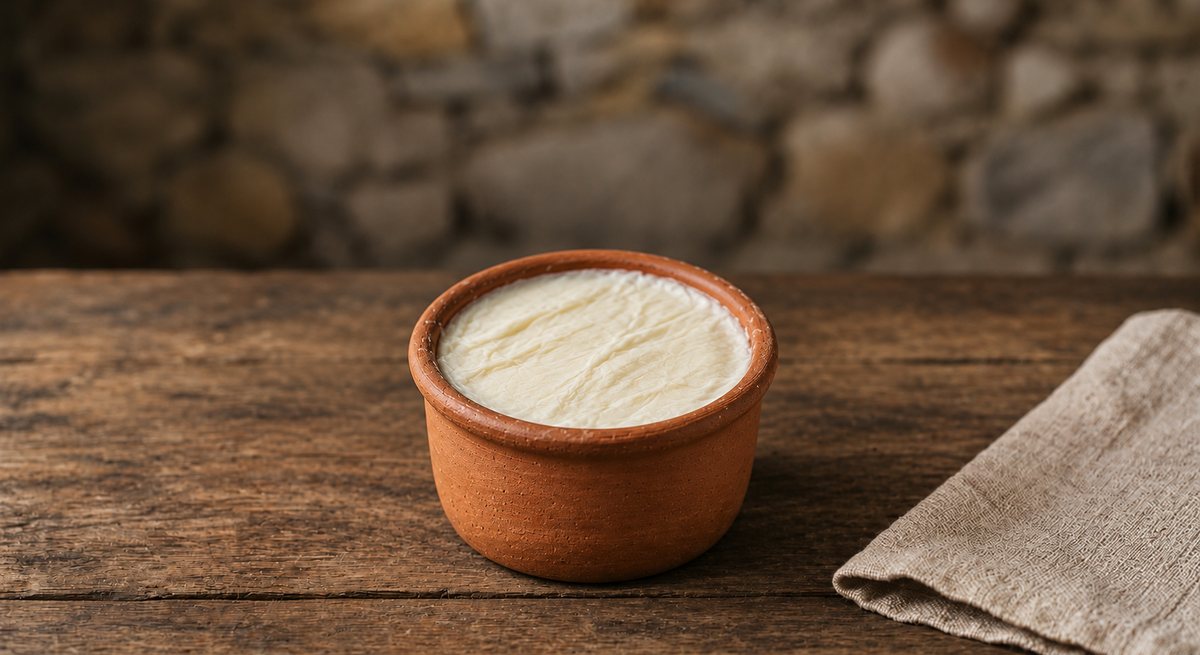
TraditionalTraditional yogurt with skin
Goat's Milk Yogurt
Κατσικίσιο γιαούρτι
Say it: ka-tsee-KEE-see-o ya-OOR-tee
A lighter, softer yogurt from the milk of Cretan goats, set in its pot with a thin skin and a fresh, slightly tangy taste.
- Milk
- Goat
- Type
- Set yogurt, with skin
- Protein
- 3.2% minimum by law
- Protection
- Traditional, not PDO
Origin
Where it is made
Made across Crete, where goats graze the mountains and the dry hills.
Chania
Rethymno
Heraklion
Lasithi
West to east. Schematic only, not to scale.
History
The story
Goats are as much a part of Cretan herding as sheep, and their milk makes a different yogurt. Goat's milk has fewer solids than sheep's milk, so its yogurt is softer, more delicate and releases whey more easily (Domagała, 2009).
The same Greek rules apply as for sheep's milk yogurt: to be called traditional it must set in the pot with a skin, from milk whose composition has not been changed apart from the fat (Hellenic Republic, 2016).
Raw material
Milk and proportions
Whole goat's milk only, raw or pasteurised (Hellenic Republic, 2016). Milk powder is not allowed (Hellenic Republic, 2016).
From milk to cheese
How it is made
Steps follow (Dairy technology training notes, n.d.).
HeatingThe milk is heated almost to the boil and poured into the pots.
85 to 95 °C
InoculatingA little yogurt or a starter culture of Streptococcus thermophilus and Lactobacillus bulgaricus is added.
below 48 °C
SettingThe pots stand in a warm room until the yogurt sets.
43 to 45 °C, about 2 to 3 hours
CoolingThey are chilled.
4 to 7 °C
Composition
What is in it
| Protein | 3.2% minimum (goat's milk yogurt); 5.6% minimum if strained (Hellenic Republic, 2016) |
|---|
| Live cultures | at least 10 million per gram until the use-by date (Hellenic Republic, 2016) |
|---|
| Texture | softer and less firm than sheep's milk yogurt, with more whey separation (Domagała, 2009) |
|---|
Legal status
Legislation
| Status | Not registered as an EU PDO or PGI. |
|---|
| Greek Food Code | Article 82 defines yogurt and the conditions for the word “traditional” (Hellenic Republic, 2016). |
|---|
| Label | Must state that the milk is goat's milk, the fat content and the heat treatment (Hellenic Republic, 2016). |
|---|
Tasting notes
Look, smell and taste
Look
Very white, with a thin skin.
Texture
Soft and delicate; a little whey may gather on top (Domagała, 2009).
Aroma
Fresh, with a light goaty note.
Taste
Fresh and tangy, lighter than sheep's milk yogurt.
At the table
How it is used
With honey and figs; in herb sauces for grilled lamb and goat; in cold soups and dips; with fruit at breakfast.
Cook with it
Recipes
All recipes →
Traditional home recipes; quantities are indicative and vary from house to house.
Goat's milk yogurt with figs and honey
Serves 25 minutesBreakfast
Ingredients
- 400 g goat's milk yogurt Crete
- 4 fresh or dried figs, quartered
- 2 tbsp honey Crete
- 1 tbsp toasted sesame
Method
- Spoon the yogurt into bowls.
- Add the figs, drizzle with honey and sprinkle with sesame.
Yogurt and herb sauce for grilled lamb
Serves 410 minutesSauce
Ingredients
- 300 g goat's milk yogurt Crete
- 1 small garlic clove, crushed
- 2 tbsp chopped mint
- 1 tbsp chopped dittany or oregano Crete
- 2 tbsp extra virgin olive oil Crete
- salt, lemon juice
Method
- Mix all the ingredients and chill for 20 minutes.
- Serve with grilled lamb or goat chops, or with roast vegetables.
Cold cucumber and goat's milk yogurt soup
Serves 415 minutesStarter
Ingredients
- 500 g goat's milk yogurt Crete
- 2 cucumbers, peeled and grated
- 1 small garlic clove
- 200 ml cold water
- 2 tbsp chopped dill or mint
- 2 tbsp extra virgin olive oil Crete
- salt
Method
- Whisk the yogurt with the water until smooth.
- Stir in the cucumber, crushed garlic, herbs and salt.
- Chill well and serve with a thread of olive oil.
At home
How to store it
Keep in the fridge and eat by the use-by date; once opened, within 2 to 3 days. Pour off any whey on top or stir it back in.
Share
Product card
Download a card with the name of the product and a QR code that opens this page.
Take this page with you
Scan the code to open this page on your phone, or visit .
References
- Dairy technology training notes [In Greek]. (n.d.). keep.eu project attachment 20860. https://keep.eu/api/project-attachment/20860/get_file
- Domagała, J. (2009). Instrumental texture, syneresis and microstructure of yoghurts prepared from goat, cow and sheep milk. International Journal of Food Properties, 12(3), 605–615. https://doi.org/10.1080/10942910801992934
- Hellenic Republic. (2016). Greek Food and Beverages Code, Article 82: Yoghurt [In Greek; Supreme Chemical Council Decision 106/2016, Government Gazette B 2457/9.8.2016]. Independent Authority for Public Revenue. https://www.aade.gr/sites/default/files/2020-07/82-iss2.pdf