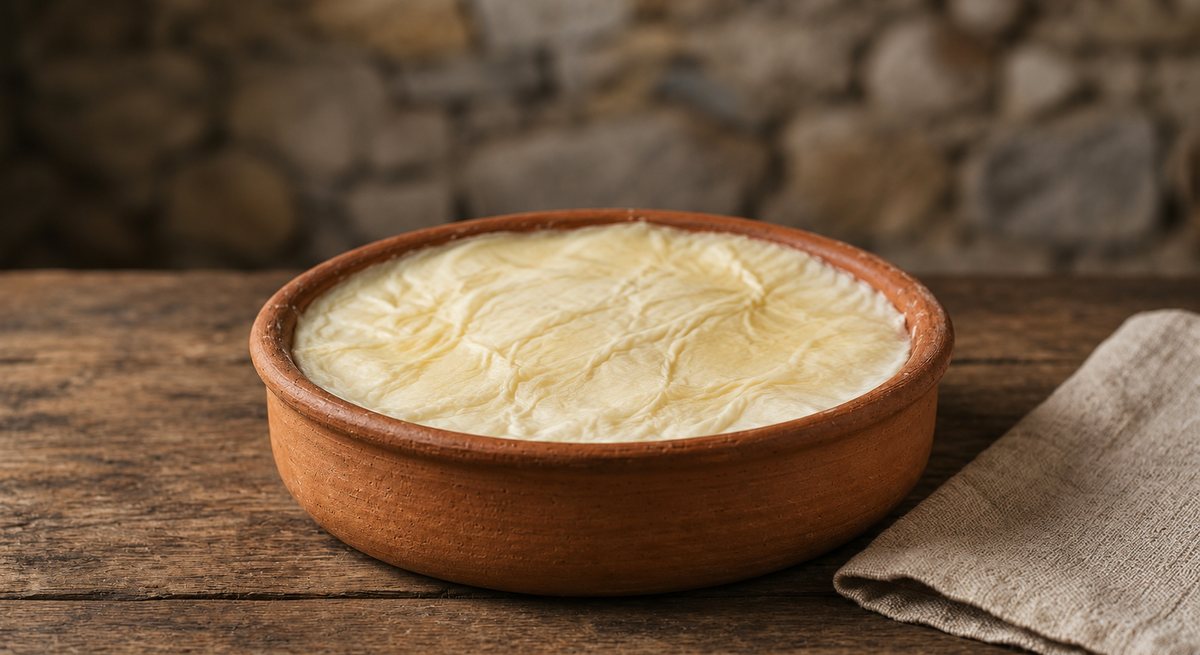
TraditionalTraditional yogurt with skin
Sheep's Milk Yogurt
Πρόβειο γιαούρτι
Say it: PRO-vee-o ya-OOR-tee
Set in its own pot from whole sheep's milk, with the thick, creamy skin (petsa) that marks a traditional Greek yogurt.
- Milk
- Sheep
- Type
- Set yogurt, with skin
- Protein
- 5.5% minimum by law
- Protection
- Traditional, not PDO
Origin
Where it is made
Made across Crete by dairies and households.
Chania
Rethymno
Heraklion
Lasithi
West to east. Schematic only, not to scale.
History
The story
In Crete yogurt was, and still is, made from the milk of the island's sheep and goats. Sheep's milk gives the firmest and richest yogurt: it has more solids, protein and fat than cow's or goat's milk (Domagała, 2009).
Greek law keeps a special name for it. A “traditional” yogurt must be set by the traditional method so that it forms a skin (petsa) on top, from milk whose natural composition has not been changed, apart from adjusting the fat (Hellenic Republic, 2016). The skin forms because the milk is not homogenised: fat and milk proteins rise and set on the surface (Nelios et al., 2023).
Raw material
Milk and proportions
Whole sheep's milk only, raw or pasteurised (Hellenic Republic, 2016). Nothing may be added except, for technical reasons, milk cream to adjust fat and milk proteins of the same species (Hellenic Republic, 2016); for a traditional yogurt the milk's composition may not be changed except for fat, as far as still lets the skin form (Hellenic Republic, 2016). Milk powder is not allowed (Hellenic Republic, 2016).
From milk to cheese
How it is made
Steps follow (Dairy technology training notes, n.d.).
HeatingThe milk is heated almost to the boil and poured into the pots it will be sold in.
85 to 95 °C
InoculatingWhen it has cooled, a little of the previous day's yogurt or a starter culture of Streptococcus thermophilus and Lactobacillus bulgaricus is added to each pot.
below 48 °C
SettingThe pots stand in a warm room until the yogurt sets and the skin forms.
43 to 45 °C, about 2 to 3 hours
CoolingThey are chilled to stop the souring.
4 to 7 °C, final pH about 4.4
Composition
What is in it
| Protein | 5.5% minimum (sheep's milk yogurt); 8% minimum if strained (Hellenic Republic, 2016) |
|---|
| Live cultures | at least 10 million per gram until the use-by date (Hellenic Republic, 2016) |
|---|
| Fat | not fixed by law; must be declared on the label (Hellenic Republic, 2016) |
|---|
Legal status
Legislation
| Status | Not registered as an EU PDO or PGI. |
|---|
| Greek Food Code | Article 82 defines yogurt, the cultures that must be used, the minimum protein and the conditions for the word “traditional” (Hellenic Republic, 2016). |
|---|
| Label | Must state the animal species the milk comes from, the fat content next to the name, and the heat treatment of the milk (Hellenic Republic, 2016). |
|---|
Tasting notes
Look, smell and taste
Look
White, with a cream-coloured skin on top.
Texture
Firm and smooth, cuts with a spoon (Domagała, 2009).
Taste
Rich and full, mildly sour.
At the table
How it is used
With thyme honey and walnuts; in tzatziki and other dips; in giaourtopita and cakes; with fruit; as a sauce for meat and vegetables.
Cook with it
Recipes
All recipes →
Traditional home recipes; quantities are indicative and vary from house to house.
Sheep's milk yogurt with thyme honey and walnuts
Serves 25 minutesBreakfast or dessert
Ingredients
- 400 g traditional sheep's milk yogurt Crete
- 3 tbsp thyme honey Crete
- 40 g walnuts, roughly chopped
Method
- Spoon the yogurt into bowls, keeping some of the skin on top.
- Pour over the honey and scatter with walnuts.
Tzatziki with sheep's milk yogurt
Serves 615 minutesMeze
Ingredients
- 500 g sheep's milk yogurt, drained for 2 hours in a cloth Crete
- 1 cucumber, grated and squeezed dry
- 2 garlic cloves, crushed
- 2 tbsp extra virgin olive oil Crete
- 1 tbsp vinegar
- dill, salt
Method
- Mix the drained yogurt with the cucumber, garlic, vinegar and salt.
- Stir in the olive oil and dill and chill for at least 30 minutes before serving.
Giaourtopita: yogurt cake with syrup
Serves 121 hour 15 minutesDessert
Ingredients
- 400 g sheep's milk yogurt Crete
- 4 eggs
- 200 g sugar
- 120 ml extra virgin olive oil or sunflower oil
- 300 g self-raising flour
- zest of 1 lemon
- Syrup: 300 g sugar, 300 ml water, 1 strip lemon peel, 1 tbsp honey Crete
Method
- Boil the syrup ingredients for 5 minutes and let them cool.
- Beat the eggs with the sugar until pale, then mix in the yogurt, oil and lemon zest.
- Fold in the flour, pour into an oiled 25 x 35 cm tin and bake at 180 °C for 40 to 45 minutes.
- Pour the cool syrup over the hot cake and let it soak in before cutting.
At home
How to store it
Keep in the fridge and eat by the use-by date. Once opened, finish within 2 to 3 days. Do not stir in the skin if you want to keep the pot firm.
Share
Product card
Download a card with the name of the product and a QR code that opens this page.
Take this page with you
Scan the code to open this page on your phone, or visit .
References
- Dairy technology training notes [In Greek]. (n.d.). keep.eu project attachment 20860. https://keep.eu/api/project-attachment/20860/get_file
- Domagała, J. (2009). Instrumental texture, syneresis and microstructure of yoghurts prepared from goat, cow and sheep milk. International Journal of Food Properties, 12(3), 605–615. https://doi.org/10.1080/10942910801992934
- Hellenic Republic. (2016). Greek Food and Beverages Code, Article 82: Yoghurt [In Greek; Supreme Chemical Council Decision 106/2016, Government Gazette B 2457/9.8.2016]. Independent Authority for Public Revenue. https://www.aade.gr/sites/default/files/2020-07/82-iss2.pdf
- Nelios, G., Nikolaou, A., Papazilakis, P., & Kourkoutas, Y. (2023). Developing new high-protein-content traditional-type Greek yoghurts based on Jersey cow milk. Dairy, 4(1). https://doi.org/10.3390/dairy4010017