TraditionalTraditional butter
Stakovoutyro
Στακοβούτυρο
Say it: sta-ko-VOO-tee-ro
The golden butter that separates when staka is cooked with flour: the traditional cooking fat of Cretan wedding pilaf and sweets.
- Made from
- Staka (sheep and goat cream)
- Type
- Butterfat
- Use
- Cooking and baking
- Protection
- Traditional, not PDO
Origin
Where it is made
Made across Crete wherever staka is made.
Chania
Rethymno
Heraklion
Lasithi
West to east. Schematic only, not to scale.
History
The story
When staka is cooked slowly with a little flour, the butterfat separates from the proteins. That fat is poured off and kept: it is stakovoutyro, “staka butter” (Papadimitriou et al., 2024).
It goes into the wedding pilaf, gamopilafo, and into pastries (Table Journey, n.d.).
Raw material
Milk and proportions
Made from staka, the cream of sheep's milk or sheep's and goat's milk (Papadimitriou et al., 2024).
From milk to cheese
How it is made
MeltingStaka (cream) is melted slowly in a pot.
low heat
SeparatingA little flour, salt and water are added and the mixture is stirred; the flour binds the proteins and the fat separates (Cantina, n.d.-b).
StrainingThe fat is strained through cloth into a jar: this is the stakovoutyro. What stays behind is cooked staka (Cantina, n.d.-b).
StoringThe butter is kept in a glass jar in the fridge (Cantina, n.d.-b).
Composition
What is in it
| Composition | No published analysis. It is almost pure milk fat. In the one published sample where the butter had been removed, the staka left behind had the lowest fat and the highest protein (Papadimitriou et al., 2024). |
|---|
Legal status
Legislation
| Status | Traditional product, not registered as an EU PDO or PGI. |
|---|
| Greek Food Code | No definition of its own. The nearest category is melted butter, obtained by melting fresh butter, with no more than 1% moisture and 1% salt (Hellenic Republic, 2009); stakovoutyro is made differently, from cooked cream. |
|---|
Tasting notes
Look, smell and taste
Look
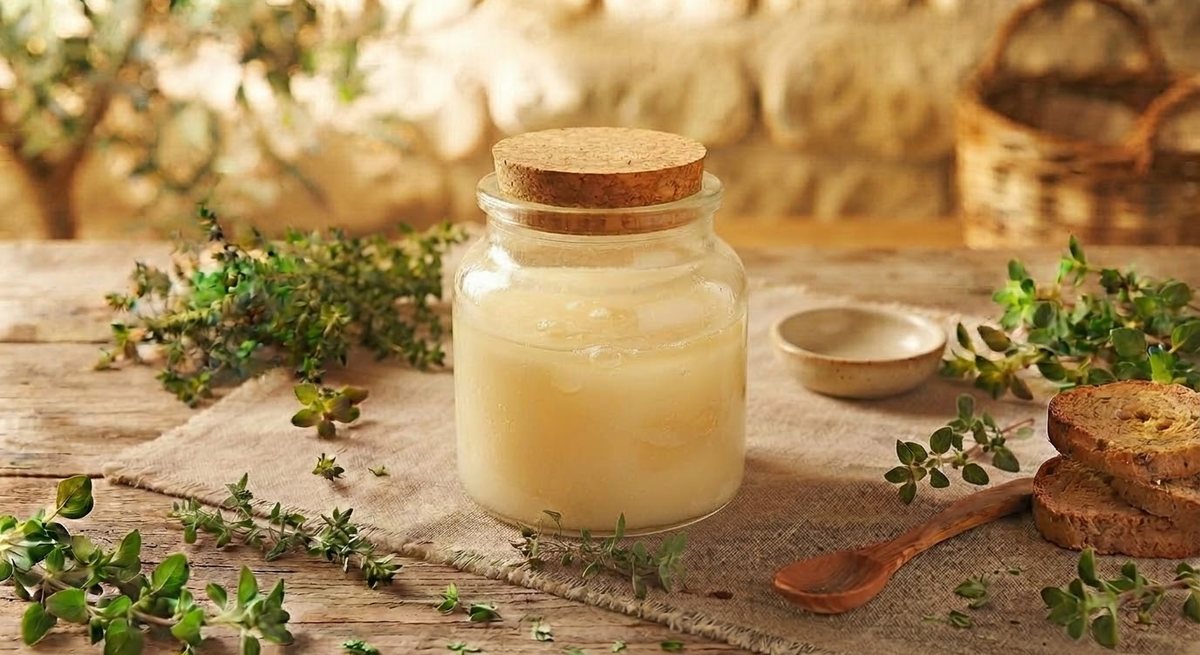
Clear golden yellow when warm, pale and grainy when cold.
Texture
Soft and spreadable from the fridge.
Aroma
Nutty, browned butter.
Taste
Rich, buttery and slightly nutty.
At the table
How it is used
Stirred into gamopilafo, the Cretan wedding pilaf, with lemon (Table Journey, n.d.; Facaros, n.d.-c); in kourabiedes and other traditional sweets; for frying eggs and potatoes.
Cook with it
Recipes
All recipes →
Traditional home recipes; quantities are indicative and vary from house to house.
Gamopilafo: Cretan wedding pilaf
Serves 62 hours 30 minutesMain course
Ingredients
- 1.5 kg lamb, goat or rooster, in pieces
- 450 g short-grain rice (e.g. Carolina)
- 2.5 litres of the meat broth
- 3 to 4 tbsp Stakovoutyro Crete
- juice of 1 to 2 lemons
- salt, pepper
Method
- Simmer the meat in salted water for about 1 hour 30 minutes, skimming, until tender. Remove it and keep it warm.
- Strain the broth and bring 2.5 litres of it back to the boil.
- Add the rice and simmer, stirring now and then, for about 20 minutes, until creamy.
- Take off the heat and stir in the lemon juice and the Stakovoutyro.
- Serve with the meat on top.
Kourabiedes with Stakovoutyro
about 30 pieces1 hourSweet
Ingredients
- 250 g Stakovoutyro, at room temperature Crete
- 80 g icing sugar, plus extra to coat
- 1 egg yolk
- 2 tbsp raki (tsikoudia) Crete
- 150 g almonds, toasted and chopped
- about 500 g flour
- 1 tsp baking powder
Method
- Beat the Stakovoutyro with the icing sugar until white and fluffy, then beat in the yolk and raki.
- Add the almonds, then work in the flour and baking powder until the dough is soft and no longer sticky.
- Shape into small crescents or balls and bake at 170 °C for 20 to 25 minutes, until pale golden.
- Coat in icing sugar while still warm.
Potatoes and eggs fried in Stakovoutyro
Serves 225 minutesBreakfast
Ingredients
- 3 tbsp Stakovoutyro Crete
- 2 potatoes, in thin slices
- 3 eggs
- salt, dried oregano
Method
- Fry the potatoes slowly in the Stakovoutyro until soft and golden.
- Beat the eggs with salt, pour over the potatoes and stir gently until just set.
- Sprinkle with oregano and serve.
At home
How to store it
Keep in a closed glass jar in the fridge (Cantina, n.d.-b); it keeps for weeks.
Share
Product card
Download a card with the name of the product and a QR code that opens this page.
Take this page with you
Scan the code to open this page on your phone, or visit .
References
- Cantina. (n.d.). Staka: I gefsi symvolo tis Kritis [Staka: the taste that symbolises Crete; In Greek]. https://cantina.protothema.gr/chrisima/themata-chrisima/staka-i-gefsi-symvolo-tis-kritis-kai-pos-tha-ti-ftiaxete-sto-spiti/
- Facaros, D. (n.d.). Gamopilafo. In Greek food decoder. https://www.facarospauls.com/apps/greek-food-decoder/25375/gamopilafo
- Hellenic Republic. (2009). Greek Food and Beverages Code, Article 81: Cream, butter and milk fats [In Greek]. Independent Authority for Public Revenue. https://aade.gr/sites/default/files/2020-03/81-iss1.pdf
- Papadimitriou, K., Georgalaki, M., Anastasiou, R., Alexandropoulou, A.-M., Manolopoulou, E., Zoumpopoulou, G., & Tsakalidou, E. (2024). Study of the microbiome of the Cretan sour cream Staka using amplicon sequencing and shotgun metagenomics and isolation of novel strains with an important antimicrobial potential. Foods, 13(7), 1129. https://doi.org/10.3390/foods13071129
- Table Journey. (n.d.). Staka. https://tablejourney.com/greece/dish/staka/